
Build or Buy an AI Chatbot Solution for Ecommerce in 2026?
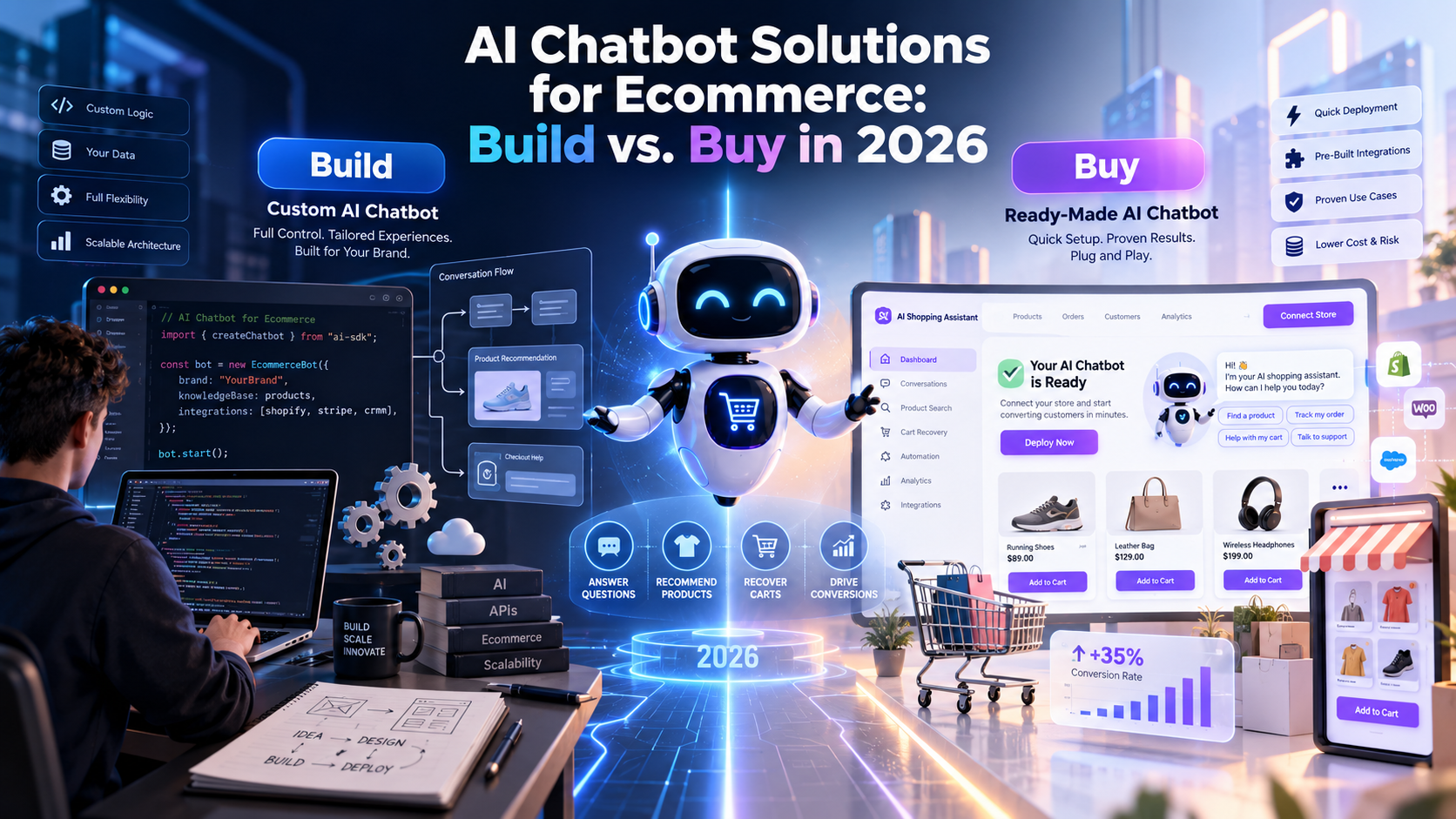
A few years ago, an ecommerce chatbot was a scripted FAQ box. It answered "where is my order?" and passed everything else to a human. The bar in 2026 is higher. Agentic checkout protocols — standards for AI agents that browse, compare, and check out on a shopper's behalf — are beginning to emerge: OpenAI has launched Instant Checkout in ChatGPT with Etsy, with Shopify next, running on an Agentic Commerce Protocol it built with Stripe. Platforms are embedding assistants of their own. Most ecommerce teams are still on a simpler question: build a chatbot, or buy one?
An ecommerce chatbots arecustomer-facing assistants that answers product, order, shipping, return, and recommendation questions using store data — catalog records, policies, reviews, pricing, inventory, and customer context. The difference between a basic chatbot and an enterprise-grade one is not the model alone; it is how reliably the assistant connects to fresh, governed ecommerce data.
Most build-vs-buy guides get the short answer wrong. This is not a decision about the bot. It is a decision about your data. The model is the easy part. Whether the bot gives a correct answer depends on the catalog, review, and policy data underneath it, and keeping that data clean is the real recurring cost. GroupBWT's longer AI chatbot solution for ecommerce guide goes deep on the architecture; this piece is about the choice that comes before it. Companies that own data a generic tool cannot reach, and can keep fresh, should build. Most everyone else should buy.
The market moved — the decision didn't get easier
AI-referred traffic to retail sites is climbing — Adobe measured a 693% jump in retail site traffic from generative AI tools over the 2025 holiday season — agentic checkout protocols are shipping, and every platform is racing to add an assistant. But company maturity varies wildly. One merchant runs a single storefront with a returns plug-in; another stitches a catalog across web, WhatsApp, and Instagram. The market for AI chatbot solutions for ecommerce has split into two camps: off-the-shelf SaaS widgets you configure in an afternoon, and custom systems built around a company's own data. Knowing which camp you belong in is worth more than any model benchmark.
A useful tell hides in plain sight. Shopify's own assistant is built for the merchant, not the shopper. It helps you write product copy and read your analytics. It does not answer a customer's "does this run small?" at 2 a.m. That gap, between platform AI for store operations and a bot that actually talks to buyers, is where the build-vs-buy choice lives.
Buy SaaS when the job maps to a settings page
For a large share of stores, buying is the right answer, and saying so plainly is the honest version of this argument. When people search for the best AI chatbot solutions for ecommerce, they usually want a tool that handles order status, shipping windows, and a tidy FAQ. In rough market terms, a SaaS plan can start around $50–$200/month while a custom build often starts at $30,000 or more — and for most stores the subscription wins on return for years. Packaged tools are what the best AI chatbot solutions for ecommerce brands reach for first, and they are right to.
Buy SaaS when most of these hold:
You sell fewer than ~10,000 SKUs and your catalog is fairly stable.
Your questions are standard: returns, shipping, sizing, "where is my order?"
You run on Shopify or WooCommerce and your needs map to a settings page.
No proprietary review or pricing data has to feed the bot.
You carry no industry-specific compliance and see fewer than ~500 daily visitors.
A five-year ecommerce partnership GroupBWT ran makes the boundary concrete. It served more than 1,000 merchants on Shopify, BigCommerce, WooCommerce, and Magento 2. The same split showed up every time. When a merchant's needs mapped to configuration, a packaged tool won. The merchants who outgrew it had logic buried in checkout extensions and loyalty rules that no settings page could express.
Build custom when your data is the product
Custom wins in the opposite conditions: when the answer a shopper needs lives in data a generic widget cannot see. An enterprise AI chatbot solution for ecommerce has to ground its replies in your live catalog, your real return rules, and your own customers' words, not a model's training data.
Build custom when:
You carry 10,000+ SKUs with frequent rotation, or you run dynamic pricing and custom return rules.
You stitch one customer identity across five or more touchpoints — web, app, WhatsApp, Instagram, email.
The bot must retrieve from proprietary catalog, review, or policy data, using retrieval-augmented generation over a corpus you own.
You sell regulated goods or carry financial or healthcare data compliance obligations.
The hardest version of the build case is data a SaaS tool simply cannot reach. GroupBWT built a coupon-and-price pipeline for a Tier-1 Asian marketplace where competitor promo data sat behind verified-buyer logins. Without it, neither the pricing engine nor any downstream bot could honestly answer "is this the best deal?" Rebuilding the pipeline on fingerprint-aware clients and stealth-browser fallbacks with a producer/consumer queue lifted ingestion from roughly 500 products an hour to between 60,000 and 130,000, peaking at nearly 960,000 products in a single day. In plain terms, the data sat behind defenses an off-the-shelf widget can't get past, so only a custom pipeline could feed the bot honest competitor prices at that scale — and that ceiling is the build case in one line.
What does the inside of a custom bot look like? Take a European cosmetics enterprise on a separate engagement. The same retrieval pattern grounded its chatbot in the company's own documents. Employees asked plain-language questions and got answers straight from internal policies and product specs. A customer-facing catalog-and-FAQ bot works the same way: it reads a corpus the company owns instead of a model's general training.
The one decision that matters, in a table
If you remember one thing, make it this grid. It maps the signals above to a recommendation and, just as usefully, to the reason behind it.
Signal | Buy SaaS | Build custom | Why it matters |
Catalog size & churn | <10K SKUs, stable catalog | 10K+ SKUs, frequent rotation | A stale catalog makes the bot recommend products that no longer exist |
Question type | Standard returns, shipping, order-status FAQs | Custom rules, dynamic pricing, complex product logic | Off-the-shelf logic cannot reliably handle custom return policies or price tiers |
Data source | Public catalog and basic FAQ only | Proprietary reviews, promo, policy, pricing, or restricted data | A SaaS retriever cannot access data behind logins or buried in owned datasets |
Channels | One storefront | 5+ touchpoints with one customer identity | Multi-channel identity stitching is custom work, not a settings-page feature |
Compliance | No regulated or sensitive data | Regulated goods, healthcare, financial, or sensitive customer data | Compliance has to live in the bot's logic, not get bolted on later |
Notice the grid is not symmetrical: every "build" row is a data condition, not a feature request.
AI chatbot solutions for ecommerce customer service: what the bot actually answers
Before you choose, audit the work. A support bot rises or falls on one unglamorous exercise. List the 50 most common questions in your support inbox. If 35 or more are already answered by structured data you own — order status, return eligibility, shipping zones — a custom build will earn its keep, because those answers can be grounded and automated reliably. If most of the 50 are emotional, complaint-shaped, or one-offs, buy a tool and route to a human faster. The audit, not the prompt, predicts payback.
Two patterns from real retail work show what "grounded" buys you. Shoppers ask in their own words — "which mattress is good for back pain?", "does this run small?" — and those answers live in reviews, not product fields. One retail-tech platform turns free-text reviews from more than 70 retailers and five languages into a structured set the bot can query. The reply then comes from what customers actually wrote, not a guess. The second pattern reads a request like "red dress under $100 for a party" and splits it into filters — category, colour, price band, occasion. It then pulls matches from the live catalog the shopper can buy from.
One honest limit belongs here. Do not promise full autonomy on money. Returns and refunds are a common fraud target, so a person has to sign off. The safe version of "AI handles returns" is "AI checks eligibility and routes the case, and a person approves the refund."
The 90-day problem nobody scopes
Here is the failure mode that ends most "our AI chatbot died in production" post-mortems, and it has nothing to do with the model. The bot that works on launch day is not the bot you need on day ninety. In one production case, a retailer's catalog turned over by 40% in a single quarter. With no refresh cycle, the launch-day bot kept recommending products that no longer existed. An AI chatbot solution for ecommerce is only as current as the catalog and policies under it. That is why a knowledge-base refresh cycle belongs in the contract from day one. If no one owns that upkeep, buy SaaS and let the vendor handle it.
This points to the most under-budgeted truth in the category. Roughly 80% of a custom build's effort goes into normalising product attributes, FAQ content, and return policies, not prompt engineering or model tuning. If your data is thin — a product listed as "Red dress, cotton" and nothing more — no retrieval system makes up for it. Teams then spend months tuning prompts when the real fix was two weeks of better descriptions. The model sets the ceiling on answer quality; the data sets the floor, and the floor is what gives way first. The same team that ran the marketplace pipeline above extended it into product classification so an out-of-stock item resolves to a real, comparable substitute instead of a confident invention.
The decision in four rules
Strip away the hype and the choice comes down to four rules:
If your needs map to a settings page, buy. A packaged tool beats a custom build on cost for years.
If the answer lives in data a generic tool can't reach — restricted promo data, your own reviews, proprietary policies — build.
Whatever you choose, budget for the data, not the model. The 50-query audit comes first, attribute normalisation next, prompts last.
Put a refresh cycle in the contract, and keep a human on anything involving money.
The strongest AI chatbot solution for ecommerce in 2026 is not the one with the cleverest model. It is the one built on data you control and keep current. GroupBWT's work across nearly 50 ecommerce and retail data projects points the same way: teams that treat the chatbot as a data challenge ship bots that survive past launch, while teams that treat it as a prompting exercise rebuild within a year. If your catalog or data situation sounds like the build case above, the team scopes these projects in a single call.
FAQ
Is it cheaper to build or buy an AI chatbot for an ecommerce store? For most stores, buying is cheaper for years. A subscription that can start around $50–$200/month handles standard returns, shipping, and FAQ questions for a fraction of a custom build that often starts at $30,000 or more, and it spreads maintenance across the vendor's whole customer base.
Custom only pays back when the bot has to reach data a packaged tool can't — large rotating catalogs, your own reviews, restricted pricing data, or compliance logic. Run the math against the value of the answers only you can give, not against the model.
When does a store outgrow a SaaS chatbot? Usually when its logic stops mapping to a settings page. The usual triggers: crossing roughly 10,000 SKUs, adding dynamic pricing or custom return rules, or joining one customer's activity across web, WhatsApp, and Instagram.
Past that point a configurable widget starts giving answers that sound on-brand but are factually wrong. When the cost of those wrong answers exceeds the cost of a build, you have outgrown it.
Why do AI chatbots get worse a few months after launch? Because the catalog changes and the bot does not. Catalogs can turn over fast — in one case a retailer's catalog shifted by 40% in a single quarter — so a bot indexed on launch-day data starts recommending discontinued items and quoting old policies.
The fix is rarely a better model; it is a knowledge-base refresh cycle that re-indexes the catalog, FAQs, and return rules on a schedule. Plan for that upkeep on day one, or let a SaaS vendor own it for you.
Can an AI chatbot handle returns and refunds on its own? It can handle the eligibility check and the routing, but a human should approve the money. Returns and refunds are a common fraud vector, so full autonomy on financial operations invites abuse.
The defensible design lets the bot confirm whether an order qualifies, collect the details, and open the case, then hands the approval to a person. That keeps the speed customers want without losing the control finance needs.
What data do I need before building a custom chatbot? Start with the 50 most common questions in your support inbox. Check how many you can already answer from data you own: order status, return eligibility, shipping zones, product attributes. Then close the gaps. Roughly 80% of a build's effort goes into cleaning up attributes, FAQ content, and policies, not writing prompts.
Thin product data defeats even a strong model. Structure the data first, and the model choice barely matters.