
5 Best Omnichannel AI Customer Service Agents in 2026
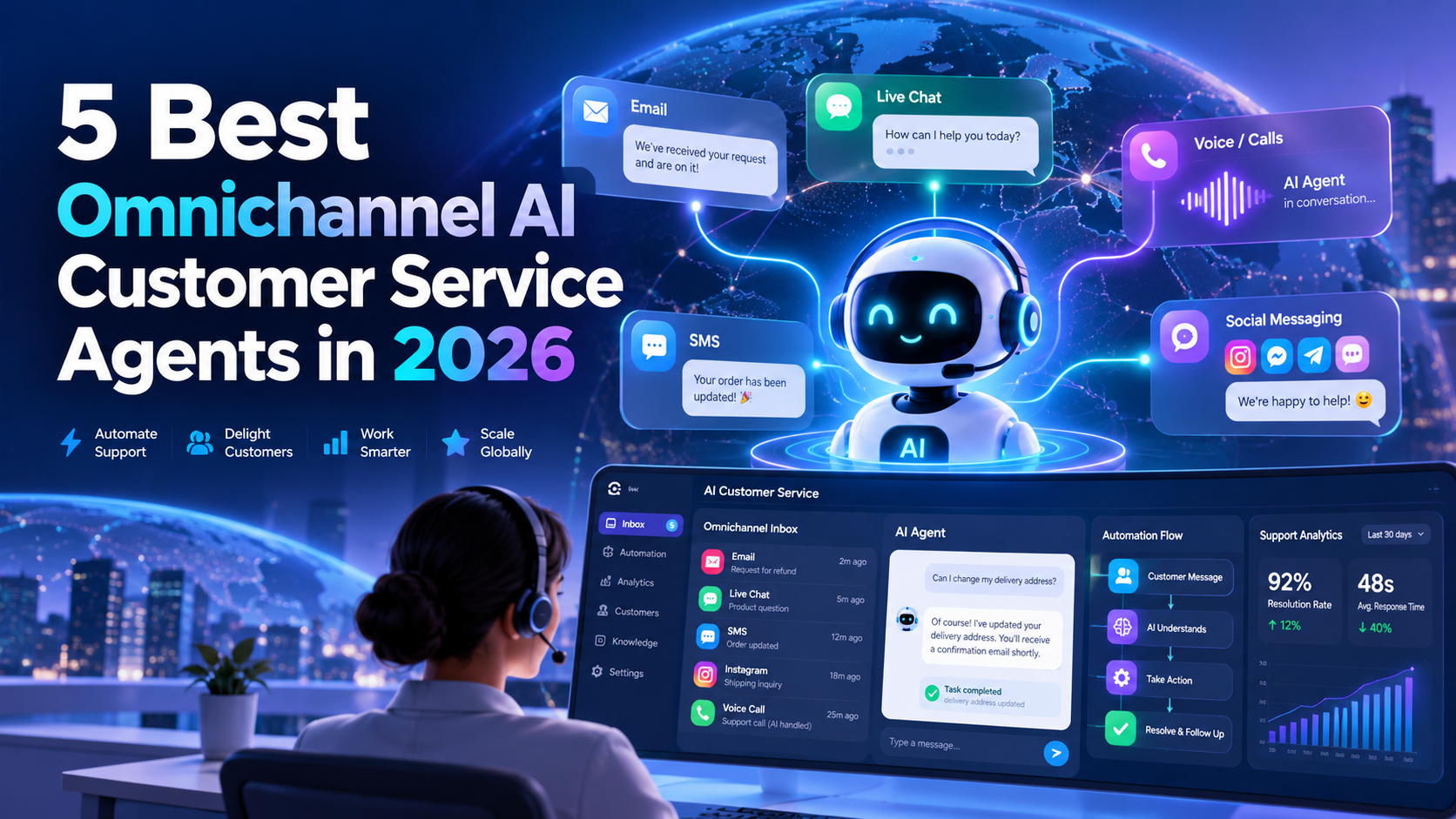
Customers no longer pick one way to reach a business. They ask a question in website chat, follow up on WhatsApp, send an order number by email, and comment on an Instagram post, often within the same day. Each message expects a fast, accurate reply, and each lands in a different app.
For support teams, that spread creates real problems: duplicated work, lost context, slow responses, and agents who spend more time switching tabs than solving issues.
Omnichannel AI customer service agents address this directly. They bring conversations from every channel into one place, answer common questions automatically using your own knowledge base, run routine workflows, and hand complex cases to a human with the full history attached. Below, we compare five leading options in 2026 and explain how to choose between them.
What Is an Omnichannel AI Customer Service Agent?
A traditional chatbot usually lives on one channel and follows scripted decision trees. If a customer types something the script didn't anticipate, the bot stalls, and if the customer moves to another channel, the conversation starts from zero.
An omnichannel AI customer service agent works differently:
Multiple channels, one brain. It answers across website chat, messaging apps, email, and social channels using the same AI model and rules.
Shared customer history. It keeps context from earlier conversations, so customers don't repeat themselves when they switch channels.
Knowledge-base answers. It generates responses from your help center, documents, and website content rather than fixed scripts.
Automated workflows. It can take actions such as checking an order, tagging a ticket, or collecting details before routing.
Human handoff. When a request is too complex or sensitive, it passes the conversation to a human agent with everything that's been said so far.
5 Best Omnichannel AI Customer Service Agents in 2026
1. WellyOn
WellyOn is an AI customer service platform built around an omnichannel inbox and an AI agent called Welly. Welly learns from a company's website and uploaded documents, answers customers across channels, and hands conversations to human agents when needed. It suits support teams that want AI automation and live human support in one workspace.
Key features:
Supported channels: Live chat and website widget, WhatsApp, Telegram, Instagram, Messenger, LinkedIn, Viber, SMS, and email.
Omnichannel inbox: All conversations land in one shared inbox, so agents follow every thread without switching apps.
AI knowledge base: Welly trains on your website, documents, PDFs, FAQs, and screenshots, and relearns as that content changes.
Shared customer context: Conversation history and customer profiles stay attached across channels and handoffs.
Human handoff: Complex conversations pass to the support team with the full transcript and customer profile.
Visual workflow builder: Drag-and-drop AI flows route inquiries and resolve common requests, with AI decision steps where judgment is needed.
Status page and branding: A built-in public status page notifies subscribers during incidents, and the agent's name, logo, colors, and tone are customizable.
Best for: Teams that want one platform for AI answers, a shared inbox, custom workflows, and incident communication across many messaging channels.
Pricing: Free trial available; contact WellyOn for current plan pricing.
2. Intercom Fin
Fin is the AI agent from Intercom, which now brands itself as Fin. It resolves customer questions using your help content and connected data, and runs either inside Intercom's helpdesk or on top of tools like Zendesk and Salesforce. In June 2026, Salesforce agreed to acquire the company, with Fin set to join its Agentforce platform.
Key features:
Supported channels: Web and in-app chat, email, and messaging channels such as WhatsApp, SMS, and social, with usage fees on some channels.
Unified inbox: The Intercom suite includes a shared inbox, ticketing, and a help center.
AI knowledge sources: Fin answers from help center articles, internal content, and connected data sources.
Context retention: Conversations and customer data stay attached within the Intercom workspace.
Escalation: Fin hands unresolved conversations to human agents inside the inbox.
Workflow automation: Intercom Workflows let teams build automated routing and actions.
Reporting: Built-in reports track resolution rates and AI performance.
Best for: Mid-size and larger support teams that want high AI resolution rates and can work with usage-based pricing.
Pricing: Fin costs $0.99 per resolution. Intercom seats start at $29 per seat per month (Essential, billed annually). Standalone Fin carries a monthly minimum.
3. Gorgias AI Agent
Best for omnichannel customer service in e-commerce.
Overview. Gorgias is a helpdesk built for online stores, with deep Shopify integration. Its AI Agent resolves common shopper questions, such as order status, returns, and cancellations, using live store data and your help center. Gorgias prices by ticket volume rather than agent seats, with unlimited users on every plan.
Key features:
Supported channels: The helpdesk covers email, chat, social channels, SMS, and voice; the conversational AI Agent focuses mainly on email and chat.
Unified inbox: All store conversations sit in one helpdesk alongside customer order details.
Knowledge and store data: The AI Agent uses your help center and live Shopify order data to answer.
Order context: Agents and AI see order history next to each conversation.
Human escalation: Conversations the AI can't resolve move to human agents in the same helpdesk.
Automated actions: The AI can handle tasks like order tracking, returns, and subscription changes.
Integrations: Strong e-commerce ecosystem, led by Shopify.
Best for: Shopify and e-commerce brands with high volumes of order-related questions.
Pricing: Helpdesk plans start at $10 per month. The AI Agent is an add-on at $1.00 per resolution monthly, or $0.90 on annual plans, and each AI resolution also counts as a billable ticket.
4. Freshdesk Freddy AI
Freddy AI is the AI layer inside Freshworks' Freshdesk helpdesk. It has three parts: Freddy AI Agent for customer-facing automation, Freddy AI Copilot for human agents, and Freddy AI Insights for analytics. It fits teams already running ticket-based support who want AI added to an established helpdesk.
Key features:
Supported channels: Email and chat in Freshdesk; Freshdesk Omni adds wider messaging and social channels.
Ticket management: A mature ticketing system with a shared team inbox.
Knowledge-base integration: Freddy AI Agent answers from your Freshdesk knowledge base.
Ticket classification and routing: AI tags, prioritizes, and routes tickets, with skills-based routing on Enterprise.
Human escalation: Unresolved conversations pass to agents as tickets.
Agent productivity: Copilot drafts replies and summarizes conversations for human agents.
Integrations: Connects with the wider Freshworks suite and a large app marketplace.
Best for: Support teams that want AI on top of a structured, ticket-driven helpdesk.
Pricing: Freshdesk plans run $19 to $89 per agent per month (annual); Freshdesk Omni runs $29 to $119. Freddy AI Agent sessions cost $49 per 100 on Freshdesk or $100 per 1,000 on Omni, with 500 free sessions on Pro and Enterprise. Copilot is $29 per agent per month.
5. Ada
Ada is an enterprise AI customer service platform from Toronto. Its AI agent resolves conversations across messaging, email, and voice, takes actions through connected systems, and hands off to people when needed. Ada is a standalone AI layer that connects to your existing helpdesk rather than replacing it.
Key features:
Supported channels: Web chat, in-app, email, voice, social, and SMS, in dozens of languages.
Conversation management: Ada handles the AI side and connects to your helpdesk for human work, rather than offering its own full inbox.
Knowledge management: The agent answers from your support content, and teams can coach and improve it.
Automated resolutions: Ada Playbooks train the agent to follow standard procedures, such as refunds or trial extensions.
Escalation: Customers are passed to human agents in your connected helpdesk.
Integrations: Connects to CRMs, helpdesks, and back-end systems to take real actions.
Reporting: Performance tracking and compliance tools.
Best for: Large enterprises with high support volume, many languages, and complex back-end systems.
Pricing: Custom pricing only; contact Ada sales for a quote.
How to Choose the Best Omnichannel AI Customer Service Agent
The right platform is the one that fits how your customers already reach you and how your team already works. Evaluate these six factors before you commit:
Supported channels. List the channels your customers actually use, then check that the AI agent, not just the wider platform, works on each one.
AI response accuracy. Look for answers grounded in your own knowledge base, and test the agent on real customer questions during a trial.
Conversation continuity. Check whether customer context carries over when someone moves from chat to WhatsApp to email.
Human handoff. Make sure agents receive the full transcript and customer details, so customers never repeat themselves.
Workflow customization. Consider whether you can automate your own processes, such as refunds, bookings, or routing, without developer help.
Pricing and scalability. Compare pricing models, not just sticker prices. Per-resolution, per-session, per-seat, and per-ticket fees scale very differently as volume grows, so model your expected monthly conversations before deciding.
Conclusion
Omnichannel AI customer service agents give businesses faster response times, consistent answers on every channel, and far less manual work for support teams. The best ones also keep customer context intact and pass complex issues to people without losing the thread.
There is no single winner for every business. WellyOn suits teams that want a unified inbox, many messaging channels, and custom workflows in one place. Fin and Ada lean toward high-volume and enterprise automation, Gorgias toward e-commerce, and Freddy AI toward ticket-driven helpdesks. Match the platform to your channels, automation needs, budget, and existing support setup.