
6 Tools for Validating AI-Generated Code Before It Reaches Production
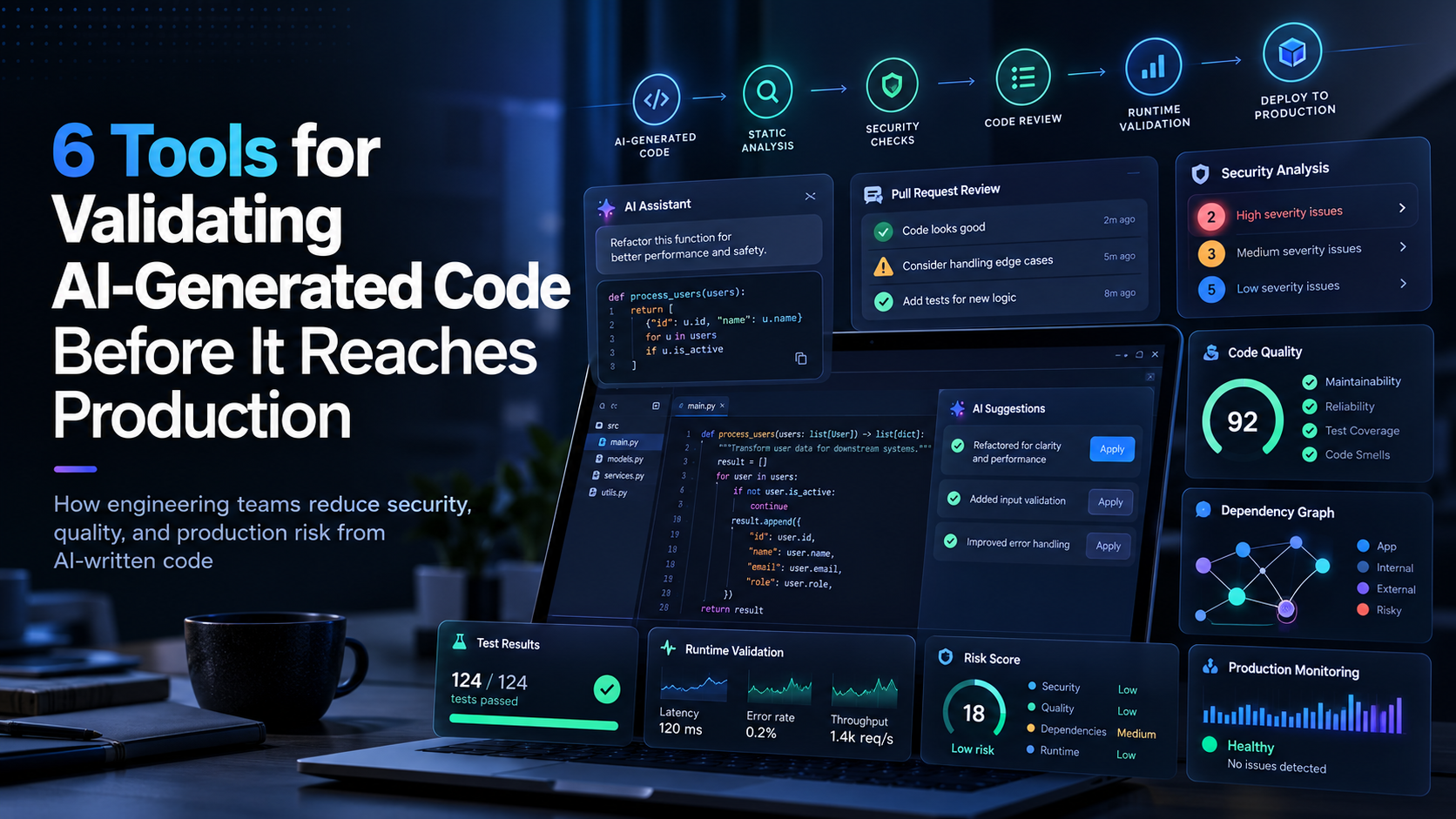
AI coding assistants can generate working code faster than engineering teams can review it. A developer might use an agent to implement a feature, modify several services, and open a pull request in minutes. Yet passing tests and receiving an AI code review does not necessarily mean those changes will behave correctly under real production traffic.
The challenge is no longer limited to detecting syntax errors or insecure code. AI-generated changes can introduce performance regressions, unexpected dependencies, and failures that only become apparent when new code interacts with existing application behavior. Engineering teams need validation processes that account for security, code quality, functional correctness, and production risk.
6 Tools for Validating AI-Generated Code Before It Reaches Production
1. Hud
Hud is a runtime intelligence platform designed to help engineering teams validate AI-generated code using real production behavior. Its Runtime Code Sensor continuously collects function-level execution information and makes that context available during development, pull request review, deployment, and remediation.
Unlike conventional code review tools that primarily examine source code, Hud evaluates changes against how the affected functions actually operate in production. The platform captures invocation counts, execution durations, exceptions, and relationships between functions, creating an aggregated call graph of application behavior.
This enables Hud to identify the potential operational impact of a code change before it reaches production. For example, a modification to a frequently executed function used by several application endpoints may receive greater scrutiny than a change affecting rarely executed code.
Hud brings that runtime information into pull request validation. Its PR risk checks evaluate changed functions and return a verdict such as Safe to merge, Review required, or High risk. Teams can use these results as approval requirements within their development workflows.
The platform also connects with coding agents through its Model Context Protocol (MCP) server, allowing AI assistants to access runtime information while generating, reviewing, or correcting code.
Key capabilities include:
● Runtime Code Sensor: Automatically instruments supported backend services and collects function-level execution data without requiring manual instrumentation of individual functions.
● Production-aware PR validation: Evaluates proposed changes against actual function usage, latency, errors, and application dependencies.
● Risk-based merge gates: Provides Safe to merge, Review required, and High risk classifications, with policy controls for enforcing approval requirements.
● Blast-radius analysis: Identifies affected functions, their production traffic, and the endpoints or execution paths that depend on them.
● Agentic runtime context: Connects coding agents such as Claude Code, Cursor, and Codex to production behavior through Hud MCP.
● Function-level release verification: Compares deployed functions against learned baselines and identifies performance regressions or new exceptions.
● Automated remediation: Supplies execution evidence and forensic context to coding agents that investigate failures and generate corrective pull requests.
● IDE integration: Displays function-level runtime information directly within supported development environments.
2. CodeRabbit
CodeRabbit provides AI-powered code reviews that analyze pull requests and identify potential problems before changes are merged. The platform integrates with development repositories and automatically reviews code changes, generating feedback about correctness, maintainability, security, and implementation quality.
Its review process considers the code diff alongside relevant repository context, helping it identify issues that may not be obvious when examining modified lines independently.
CodeRabbit also generates pull request summaries and organizes review findings into actionable comments. This is useful for engineering teams handling an increasing number of AI-generated pull requests, where manual reviewers may struggle to keep pace with the volume of proposed changes.
Key capabilities include:
● Automated pull request reviews: Analyzes proposed changes and provides feedback directly within repository workflows.
● Context-aware analysis: Considers relevant code and repository information when evaluating changes.
● Bug detection: Identifies potential logic errors, edge cases, and implementation problems.
● Security review: Flags suspicious coding patterns and potential security concerns.
● Pull request summaries: Generates explanations of code changes to simplify reviewer understanding.
● Interactive feedback: Allows developers to discuss findings and request clarification.
● Configurable review behavior: Supports repository-specific instructions and review preferences.
3. SonarQube
SonarQube is a static code analysis platform that helps engineering teams enforce quality and security standards throughout development. It analyzes source code to identify bugs, vulnerabilities, security hotspots, maintainability problems, and other issues that may affect software reliability.
The platform is particularly relevant for organizations using AI coding assistants because it provides consistent quality requirements regardless of whether code was written by a developer or generated by an agent.
SonarQube's pull request analysis focuses on issues introduced by proposed changes. Teams can use quality gates to establish conditions that must be satisfied before code is merged or promoted through a delivery pipeline.
Key capabilities include:
● Static code analysis: Identifies potential bugs, vulnerabilities, and maintainability issues across supported programming languages.
● Pull request analysis: Evaluates issues introduced by new code changes.
● Quality gates: Enforces configurable acceptance criteria before code advances through development workflows.
● AI Code Assurance: Supports quality standards for projects containing AI-generated code.
● Security hotspot detection: Highlights code requiring further security review.
● Code coverage evaluation: Measures test coverage against defined quality requirements.
● CI/CD integration: Incorporates automated analysis into existing build and delivery pipelines.
4. Snyk Code
Snyk Code provides AI-assisted static application security testing (SAST) designed to identify vulnerabilities in source code during development.
The platform analyzes application code to detect insecure patterns, potentially exploitable weaknesses, and data flows that could create security exposure.
For organizations adopting AI coding assistants, Snyk Code addresses the possibility that generated code may reproduce insecure implementation patterns or introduce vulnerabilities that developers do not immediately recognize.
Its analysis is designed to operate within development environments and repository workflows, allowing security findings to appear before code reaches production.
Key capabilities include:
● AI-assisted static security analysis: Identifies potential security vulnerabilities in application source code.
● Data-flow analysis: Examines how information moves through the application to identify unsafe operations.
● IDE integration: Provides security findings during development.
● Pull request scanning: Detects newly introduced vulnerabilities within repository workflows.
● Security remediation guidance: Offers information and recommendations to help developers address identified issues.
● Developer workflow integration: Connects security checks with CI/CD pipelines and source control systems.
● Broader application security coverage: Works alongside Snyk's dependency, container, and infrastructure security products.
5. CodeScene
CodeScene is a code quality and engineering intelligence platform that helps development teams identify maintainability risks, prevent technical debt, and validate AI-generated code before it reaches production.
Its approach centers on CodeHealth, a metric that evaluates source code using more than 25 structural factors associated with maintainability and defect risk.
The platform analyzes code changes to identify complexity, poor modularity, and other structural problems that can make AI-generated implementations difficult to maintain.
Through its CodeHealth MCP Server, AI coding assistants can access quality information, evaluate their changes, and address detected issues before opening pull requests.
Key capabilities include:
● CodeHealth analysis: Evaluates source code using structural maintainability metrics and identifies areas with elevated defect risk.
● AI-generated code validation: Checks AI-assisted changes against defined code quality standards before they enter the codebase.
● Automated pull request reviews: Identifies maintainability issues and provides recommendations within GitHub, GitLab, Bitbucket, and Azure DevOps workflows.
● CodeHealth quality gates: Enforces code quality requirements and can block changes that introduce unacceptable technical debt.
● MCP integration: Provides coding agents with code quality context to help them evaluate and correct generated implementations.
6. GitHub Copilot Code Review
GitHub Copilot Code Review provides AI-assisted pull request analysis directly within GitHub. The capability helps developers identify potential problems in proposed code changes and receive suggestions before merging.
It can be requested manually or configured to run automatically during different stages of the pull request lifecycle.
Copilot examines changes in the context of the repository and generates feedback addressing correctness, maintainability, and potential implementation problems.
Its review capabilities can also incorporate repository instructions and additional context, allowing organizations to guide how reviews are performed.
For teams already using GitHub as their primary development platform, Copilot Code Review provides an integrated approach that does not require developers to move into a separate review environment.
The platform also supports suggested code changes that developers can evaluate and apply.
Key capabilities include:
● Automated pull request review: Analyzes proposed code changes and provides feedback within GitHub.
● Repository context analysis: Uses relevant project information to improve review recommendations.
● Review suggestions: Identifies potential problems and proposes corrective changes.
● Custom instructions: Allows teams to define review preferences and repository-specific requirements.
● Automatic review workflows: Supports review triggers during pull request creation and subsequent updates.
● Agent-assisted improvements: Can connect review suggestions with supported Copilot coding workflows.
● GitHub integration: Works with existing pull request, repository, and development processes.
Comparison of AI-Generated Code Validation Tools
The six tools address different stages of code validation. Understanding these differences helps engineering teams determine which capabilities they need and where existing development controls may already provide sufficient coverage.These solutions are not necessarily interchangeable. A company using static analysis and AI code review may still lack information about how changed functions behave in production. Similarly, production-aware validation does not replace dedicated security testing or functional test coverage.
|
Tool |
Validation approach |
Distinguishing capability |
|
Hud |
Runtime-aware PR analysis |
Function-level production context and risk-based merge gates |
|
CodeRabbit |
AI-powered pull request review |
Context-aware automated review comments |
|
SonarQube |
Static analysis and quality gates |
Enforceable quality requirements for AI-generated code |
|
Snyk Code |
AI-assisted security analysis |
Security-focused static and data-flow analysis |
|
CodeScene |
CodeHealth analysis and automated quality gates |
CodeHealth MCP integration and automated technical debt prevention |
|
GitHub Copilot Code Review |
Repository-integrated AI review |
Native GitHub review workflows and suggested fixes |
How to Introduce Risk-Based Validation Into AI Development Workflows
Organizations adopting AI coding assistants should ensure that validation capacity develops alongside code generation capacity.
A practical approach involves integrating different checks into existing development and release workflows rather than establishing a separate approval process for every AI-generated change.
1. Apply automatic checks to every pull request. Configure static analysis, security scanning, and repository-aware reviews to run consistently. These checks should evaluate AI-generated and human-written code against the same fundamental standards.
2. Identify changes that require deeper review. Use information about modified components, application criticality, and production dependencies to determine which pull requests need additional scrutiny. Changes affecting authentication, payments, or heavily used application functions may justify stricter approval requirements.
3. Connect validation results to merge policies. Automated findings become more useful when they influence whether code can advance. Define clear conditions for blocking changes, requiring human approval, or allowing lower-risk updates to proceed.
4. Verify behavior during rollout. Passing pre-production checks does not eliminate the possibility of regressions. Compare newly deployed behavior against established baselines and identify significant changes in latency, execution patterns, and exceptions.
5. Feed production findings back into development. When problems occur, provide engineers and coding agents with the execution evidence needed to investigate the underlying cause. This creates a feedback process in which real application behavior informs future code changes.
The purpose of these controls is not to slow down every AI-assisted development task. It is to concentrate engineering attention on changes with meaningful operational consequences while automating repeatable validation activities.
Frequently Asked Questions
What is AI-generated code validation?
AI-generated code validation is the process of evaluating software produced by coding assistants or autonomous agents before it is merged or deployed. It includes functional testing, security analysis, code quality checks, and reviews of implementation correctness. More advanced approaches also examine how proposed changes could affect existing production behavior, helping engineering teams identify risks that are not visible from source code alone.
Can AI code review tools guarantee production-safe code?
No. AI code review tools can identify potential bugs, security weaknesses, and maintainability problems, but they cannot guarantee that every failure will be detected. Some issues only appear under realistic workloads or through interactions with existing systems. Organizations should combine automated reviews with appropriate testing, security controls, production-aware analysis, and post-deployment verification.
What is the difference between static analysis and runtime-aware code validation?
Static analysis examines source code without executing it, identifying issues based on code structure and known patterns. Runtime-aware validation uses information about actual application execution, including function usage, latency, errors, and dependencies. Static analysis helps enforce code quality and security standards, while runtime context helps assess how changes may affect systems operating under real production conditions.
Do engineering teams need different tools for security and code quality?
Security and code quality overlap, but they address different risks. A code quality platform may identify maintainability problems and certain vulnerabilities, while a dedicated security scanner can provide more specialized vulnerability analysis. Runtime-aware tools add information about production behavior and operational impact. Organizations should select complementary capabilities according to existing controls, application architecture, and release requirements.
Why is production data important when reviewing AI-generated code?
Production data shows how application functions behave under real workloads, including how frequently they execute, which operations depend on them, and whether they experience errors or latency problems. This information can reveal the potential impact of changing a function that appears ordinary in a code diff. For engineering teams using AI agents, runtime context helps prioritize review attention according to actual application risk.