
7 Best AI Agent Platforms for the SDLC in 2026
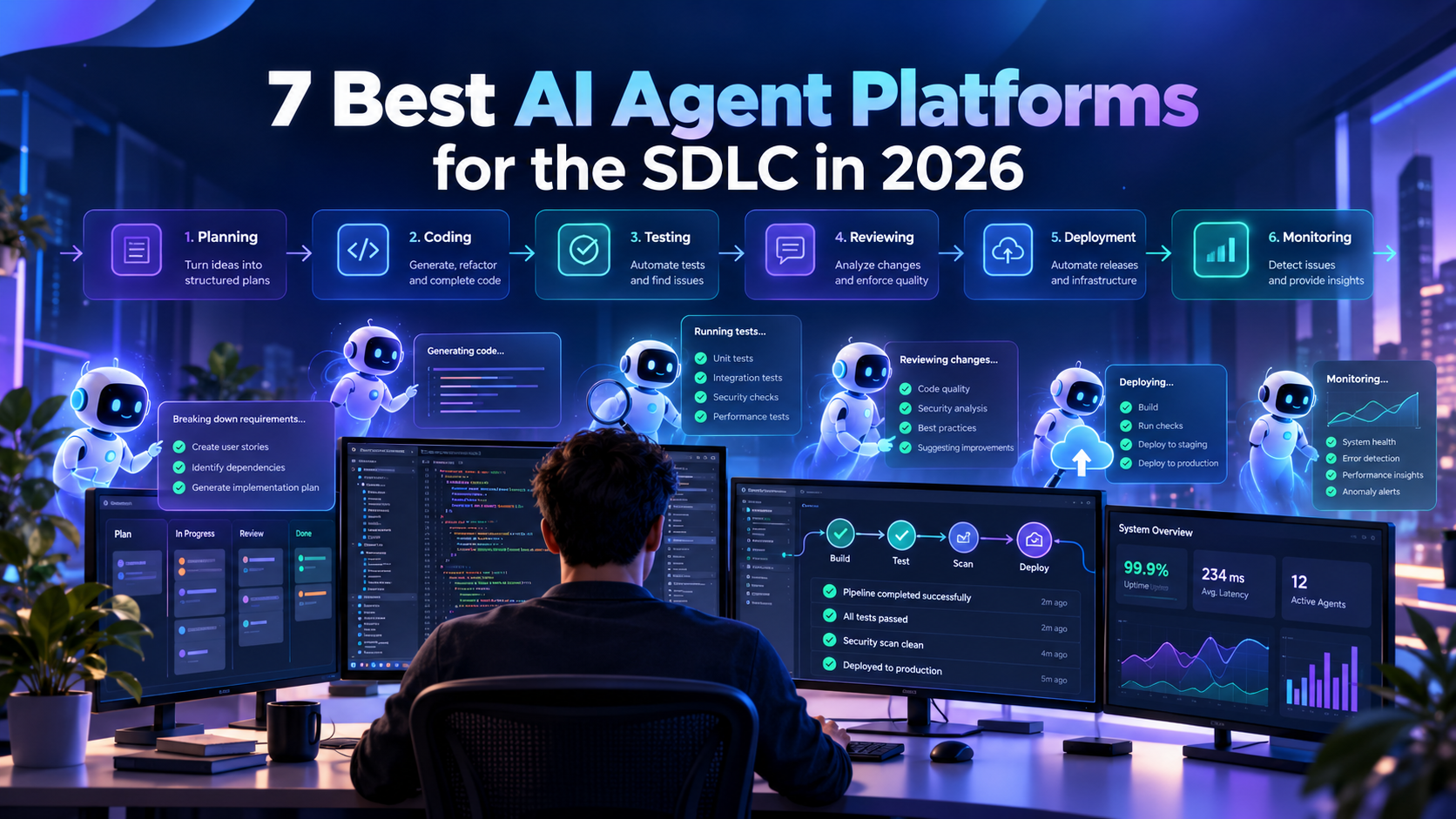
AI coding has moved beyond autocomplete. The more important shift in 2026 is that agents can now accept engineering work, investigate repositories, create plans, modify code, run tests, review changes, respond to CI failures, remediate vulnerabilities, and return completed work for approval.
That changes the buying decision for enterprise engineering teams.
What Makes an AI Agent Platform Ready for the SDLC?
An agent completing one task successfully is not the same as an enterprise agent platform. Software development contains dependencies between people, systems, and stages. A ticket may trigger planning. Planning produces an implementation. The implementation creates a pull request. CI generates evidence. Review identifies changes. Security checks may require remediation before merge.
A production-ready platform needs to preserve that chain.
The capabilities that matter most include:
- Event-driven execution: Agents should start from tickets, pull requests, CI failures, alerts, schedules, or other engineering events, not only manual prompts.
- Long-running workflows: Work needs to survive retries, human approvals, agent handoffs, and execution that lasts longer than one interactive session.
- Shared context: Agents need repository, architecture, ticket, documentation, and organizational context relevant to the task.
- Specialized agents: Planning, implementation, testing, review, and security do not always belong to the same agent.
- Verification: Generated work should be tested independently before it advances.
- Governance: Permissions, models, tools, repositories, secrets, and production access need clear boundaries.
- Human checkpoints: Enterprises need to control where autonomy ends and human judgment begins.
- Auditability: Teams should know what the agent did, what information it used, and why a change progressed.
7 Best AI Agent Platforms for the SDLC in 2026
1. Overcut - Best for Orchestrating and Governing Agentic SDLC Workflows
Overcut is designed around a fundamental enterprise problem: engineering organizations are adopting many AI agents, but the processes connecting those agents remain fragmented.
Its answer is a software factory control plane for building custom agents, connecting them to engineering systems, orchestrating multi-agent workflows, and governing how autonomous work moves through the SDLC.
The workflow is the central unit.
A real engineering event, such as a new ticket, pull request, CI failure, security finding, or scheduled maintenance task, can start an Overcut run automatically. Specialized agents then handle different stages while sharing context and passing structured outputs between them.
A ticket could move through analysis, technical design, implementation, verification, and review without a developer manually copying information between separate AI tools.
Overcut supports parallel agents, persistent workflow state, retries, priorities, workflow versioning, schedules, and explicit human approval points. That makes it suitable for processes that take hours or include stages where the system must pause while an engineer makes a decision.
Verification is built into the architecture rather than treated as a final prompt to the agent that created the work. Deterministic tests, linters, policy checks, a second-model review, and human approval can all participate before a result advances.
Enterprise governance is equally central. Teams can control agent access using RBAC, scoped repositories, allowed tools, model policies, secrets, and sandboxed execution. Overcut supports managed, private-cloud, VPC, on-premises, and air-gapped deployment patterns, with audit trails covering agent and workflow activity.
Particularly useful capabilities include:
- Custom AI agents
- Multi-agent workflow orchestration
- Event-based triggers
- Shared workflow context
- Agent memory and reusable skills
- MCP integrations
- Long-running stateful execution
- Parallel agent execution
- Governance and human approval gates
- Layered output verification
- RBAC and least-privilege controls
2. Factory
Factory has evolved from autonomous coding agents into a broader software factory architecture.
Its Droids can operate across planning, implementation, review, QA, documentation, release, incident response, and other engineering workflows rather than remaining confined to an IDE session.
Factory's model is based on continuous engineering signals.
Bug reports, customer feedback, tickets, pull requests, CI events, and operational signals can become inputs to autonomous workflows. Droids then investigate the task, perform work, validate results, and interact with the rest of the delivery system.
This event-driven approach matters because many valuable agentic tasks do not begin when a developer opens an AI interface.
A failing build should be investigated when it fails. A dependency vulnerability can create remediation work automatically. A newly created issue can begin analysis before an engineer manually picks it up.
Factory also supports model routing rather than tying its agent platform permanently to one foundation model. Different engineering activities can use different models according to their strengths, while the wider workflow remains consistent.
Relevant capabilities include:
- Autonomous Droids
- Full-SDLC task execution
- Ticket-to-code workflows
- Automated code review
- QA automation
- Documentation workflows
- Incident response
- CI/CD automation
- Model routing
3. OpenHands Enterprise
OpenHands began as an open-source software development agent and has expanded into an enterprise control plane for running agents across engineering organizations.
That combination is important for companies that want significant control over the infrastructure behind agentic software development.
OpenHands Enterprise can be self-hosted and provides centralized infrastructure for deploying, observing, securing, and automating AI agents. Organizations can use the OpenHands agents provided by the platform or bring other agents into the same operating environment.
Instead of treating every autonomous workflow as a separate script or developer experiment, the platform gives organizations common controls around agent execution.
Useful capabilities include:
- Self-hosted agent infrastructure
- Open-source agent foundation
- Agent Control Plane
- RBAC
- Guardrails
- Centralized observability
- LLM gateway
- Agent budgeting
- Repository and documentation context
- Automated GitHub workflows
- Jira and Slack triggers
- Scheduled agent execution
4. Augment Cosmos
Augment Cosmos is built around the idea that isolated agent sessions are not enough to transform software delivery. Instead, Cosmos creates persistent agent loops that connect multiple stages of the SDLC.
A ticket can trigger one agent to understand the requirement, another to implement the change, another to review it, and another to verify the behavior. Deployment and monitoring events can then continue the loop after merge.
This changes the unit of automation from a coding task to an ongoing engineering process.
Cosmos provides specialized Experts for activities such as ticket implementation, deep code review, risk analysis, verification, incident investigation, feedback triage, and project coordination. Teams can use prebuilt workflows or configure their own.
Relevant capabilities include:
- Persistent SDLC agent loops
- Specialized AI Experts
- Event-triggered execution
- Ticket-to-PR workflows
- Automated review
- Independent verification agents
- Vulnerability remediation
- Incident investigation
- Codebase-wide Context Engine
- Parallel cloud agents
5. Sourcegraph
Sourcegraph addresses one of the hardest problems in enterprise agentic development: agents often perform well inside a small repository and struggle when a task spans a large codebase.
Its platform has increasingly become an intelligence and execution layer for both developers and AI agents working across complex repositories.
Deep Search provides agentic code investigation across large codebases, allowing teams and external agents to retrieve architectural and implementation context that is difficult to obtain through local search alone.
Relevant capabilities include:
- Enterprise code search
- Deep Search agents
- Agentic Batch Changes
- Multi-repository execution
- Monorepo support
- Automated migration planning
- Delegation to coding agents
- Deterministic bulk changes
- CI feedback handling
- Merge-conflict handling
6. Qodo
As autonomous agents produce more code, review becomes a scaling problem of its own. Qodo is built around that verification layer. Rather than positioning its primary agent as another author of production code, Qodo focuses on providing independent context-aware review and code-quality governance for changes created by both developers and AI agents.
Its review system combines multiple forms of context. The platform can understand repository structure, cross-repository relationships, previous pull requests, business requirements, development standards, and the actual change being proposed.
Relevant capabilities include:
- Multi-agent code review
- Independent review of AI-generated code
- Cross-repository context
- Repository architecture understanding
- PR history context
- Business requirement context
- Centralized coding standards
- Automated policy enforcement
- IDE review
7. CodeRabbit
CodeRabbit occupies another increasingly important position in the agentic SDLC: independent verification at the point where generated work becomes a proposed software change.
As coding agents increase pull request volume, the review stage can become the limiting factor in delivery. CodeRabbit provides an automated review layer that evaluates pull requests using repository context, change history, ticket information, CI output, static analysis, and other engineering signals.
Its agentic review goes beyond summarizing a diff. The platform can investigate code relationships, identify bugs, assess cross-file impact, check security concerns, and evaluate whether a change aligns with organizational expectations.
Relevant capabilities include:
- Agentic pull request review
- Independent verification of AI-generated code
- Codebase-wide context
- Cross-file impact analysis
- Ticket and CI context
- Integrated linters and SAST
- Security review
- Organizational standards enforcement
- Automated fixes
The Agentic SDLC Has Seven Critical Handoffs
The easiest place for an agent workflow to fail is often not inside an individual agent.
It is between stages.
Enterprise teams should evaluate platforms according to how they manage these handoffs.
Ticket to Technical Intent
A ticket may describe a requested outcome without containing enough information for implementation.
An agent needs to determine scope, dependencies, acceptance criteria, affected services, and unresolved questions before coding begins.
If this handoff is weak, the organization gets fast implementation of poorly defined work.
Technical Intent to Plan
Once the requirement is understood, the system needs an executable plan.
For complex work, this may involve multiple repositories, migrations, tests, infrastructure changes, or staged rollout.
The plan also creates the first meaningful human checkpoint. Reviewing intent before an agent writes hundreds of lines of code is often more efficient than correcting the resulting implementation later.
Plan to Implementation
The implementation agent needs the approved plan plus the right codebase context, tools, permissions, and development environment.
This is where agent isolation becomes important.
A task involving one service should not automatically grant access to every repository or production credential available to the engineer who created it.
Implementation to Verification
An agent saying "the tests pass" should not be treated as independent verification.
The platform should collect deterministic evidence from tests, builds, static analysis, security checks, or live validation environments.
For higher-risk changes, organizations may also want a separate reviewing agent that did not generate the implementation.
Verification to Human Review
Human reviewers need more than a large diff.
The platform should explain the intent, what changed, which checks ran, what remains uncertain, and where the greatest risk lies.
This is particularly important as autonomous agents generate larger changes.
Review to Merge
Approval should not automatically imply unlimited execution authority.
Merge rules, branch protections, governance gates, and required checks remain valuable even when agents perform much of the underlying work.
Merge to Production Feedback
Agentic development should not end at merge.
Deployment failures, incidents, security alerts, telemetry, and customer feedback can become signals that reopen the loop.
The strongest platforms increasingly treat software development as a continuous agent system rather than a sequence that ends when code enters the main branch.
What Engineering Leaders Should Measure
The value of an AI agent platform is not the number of agent runs.
High activity can coexist with poor engineering outcomes.
Useful metrics should connect autonomy with delivery performance.
Successful Autonomous Completion
What percentage of delegated tasks reach the intended checkpoint without human rescue?
A high volume of abandoned or heavily corrected runs indicates that apparent automation may still create substantial engineer workload.
Accepted Change Rate
How often does agent-generated work survive review with minimal rework?
This helps distinguish productive code generation from additional review burden.
Time From Trigger to Verified Result
Measure the complete loop, not simply model response time.
The important duration begins when the engineering event occurs and ends when a trustworthy result is available.
Human Intervention Per Workflow
Track where engineers repeatedly need to step in.
Those interruptions can reveal missing context, weak tools, poor permissions, or tasks that should be divided differently.
Verification Failure Rate
How often does implementation fail tests, code review, security analysis, or other validation?
This helps engineering leaders understand whether higher generation throughput is producing hidden quality debt.
Cost per Accepted Outcome
Token usage alone is difficult to interpret.
A more useful metric connects total model and compute consumption with accepted pull requests, resolved vulnerabilities, closed tickets, or other completed engineering outcomes.
Frequently Asked Questions
How is an AI agent platform different from a coding assistant?
A coding assistant primarily helps an individual developer during an interactive coding session. An agent platform can initiate work from engineering events, coordinate several specialized agents, preserve workflow state, use external tools, enforce permissions, and run complete processes even when a developer is not actively directing each step.
Why do agentic workflows need orchestration?
Real software tasks usually cross several stages and systems. Orchestration manages triggers, dependencies, state, retries, parallel agents, handoffs, approvals, and verification so autonomous work can move through the SDLC predictably rather than depending on developers manually connecting individual agents.
Should the same AI agent write and review code?
It can, but independent verification provides a stronger control model for important changes. A separate reviewing agent can approach the implementation without inheriting the assumptions made during generation. Deterministic testing and human review can add additional independent evidence before merge.
What permissions should software engineering agents receive?
Agents should generally receive the minimum permissions required for their assigned workflow. An implementation agent may need repository access and permission to open a pull request without needing production credentials. Higher-risk tools or environments should require tighter scopes and explicit approval gates.
Can AI agents work across the entire SDLC?
Yes. Agent platforms increasingly support planning, coding, testing, review, security remediation, CI repair, documentation, release workflows, and incident investigation. The degree of autonomy should vary according to the task, available verification, and consequences of an incorrect action.