
10 Leading Vendors for AI-Powered Software Factories
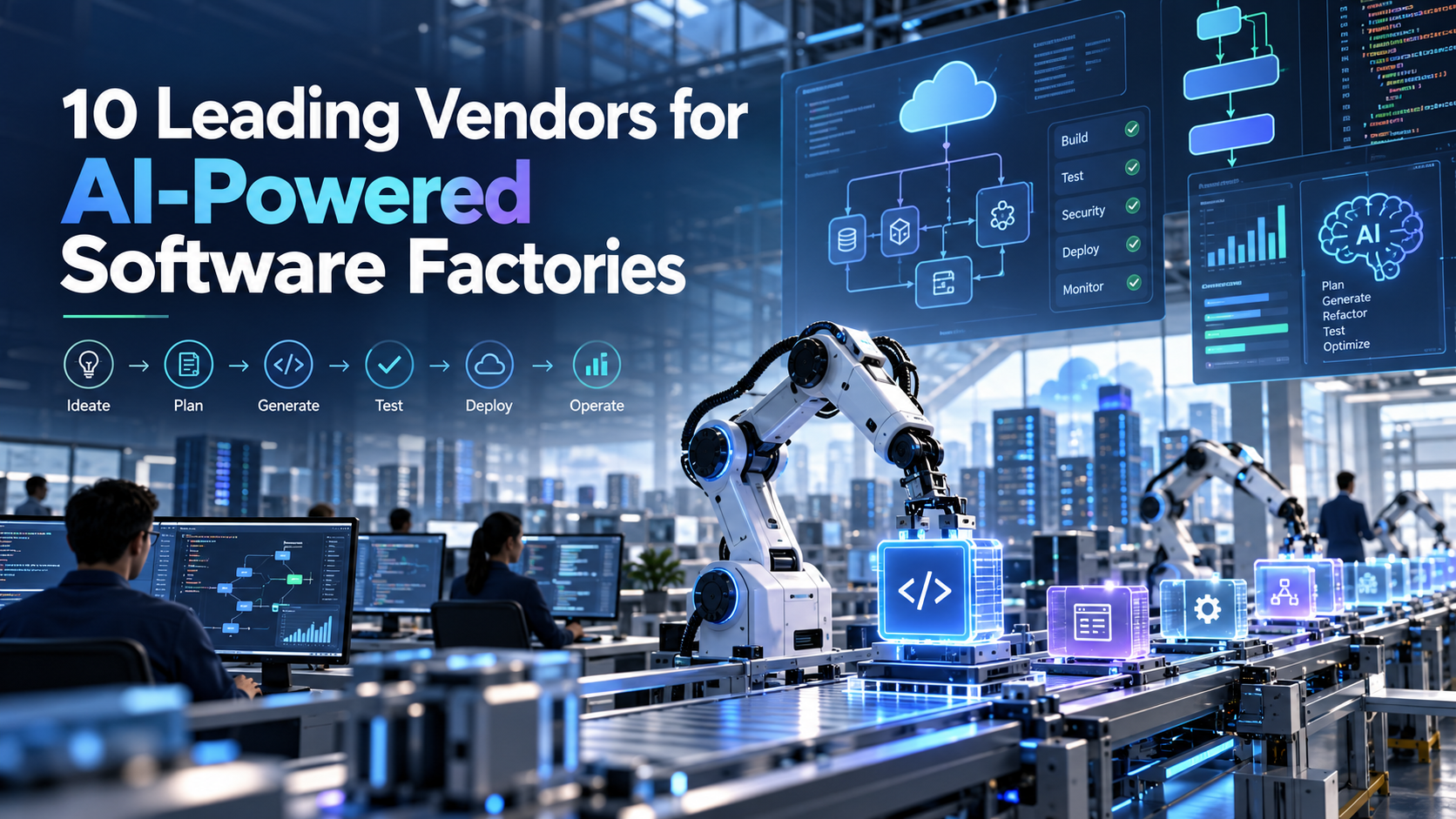
A software factory is the idea that building software should work like a production line: standardized parts, an automated assembly path, quality gates and a clear view of what is being built and by whom. What makes a factory AI-powered in 2026 is that a growing share of the work inside it, writing code, opening pull requests, provisioning environments, responding to incidents, is done by AI agents rather than people. That raises the stakes on every station of the line, because speed without control just produces defects faster.
What Makes a Software Factory AI-Powered
The label only means something when a few things are true at once:
Agents do real work: code, reviews, deployments and fixes are produced by AI, not just suggested to a human
The platform is self-service: developers and agents request environments and actions without filing tickets
Everything is modeled: services, owners, dependencies and standards live in one source of truth agents can read
Actions are governed: every automated change runs inside permissions, approvals and an audit trail
Take any one of these away and you have fast tooling, not a factory. The vendors differ most in which of these they own.
10 Leading Vendors for AI-Powered Software Factories
1. Port
Port is the control plane for an AI-powered software factory. Where most tools run one station of the line, Port sits above all of them and models the entire engineering estate in its Context Lake: services, ownership, dependencies, environments, resources, standards and operational metadata, in one structured source of truth that both engineers and AI agents can read and act on. That shared context is what keeps a factory coherent once agents, not just people, start making changes across it.
On top of that model, Port adds the parts a factory needs to run safely at speed. Workflow orchestration and self-service actions let developers and agents provision, deploy and remediate without tickets. Scorecards continuously measure services against production-readiness and security standards, and agents can act on degraded scorecards automatically. Agent management gives a single place to register, scope and oversee the agents operating in the factory, and governance wraps all of it in scoped permissions, approvals and audit trails so every automated action is accountable.
Crucially, Port does not replace the tools already on the line. It integrates with existing identity, cloud, CI/CD and developer tooling, then governs and coordinates them, which is why it fits platform-engineering teams building a factory out of components they already own rather than asking them to rip and replace.
Key features
Models the full engineering estate in a Context Lake that agents can read and act on
Orchestrates workflows and self-service actions for both developers and agents
Runs scorecards for production readiness, with agents able to act on degraded scores
Manages and scopes the AI agents operating across the factory
Enforces governance through scoped permissions, approvals and audit trails
Integrates with existing identity, cloud and CI/CD rather than replacing them
2. Humanitec
Humanitec is a platform orchestrator that automates how environments and resources are provisioned across a software delivery platform. It lets platform teams codify configuration so that every new service or environment is built from the same standardized baseline, which removes a large source of drift and manual setup. For factories whose biggest pain is inconsistent, hand-built infrastructure, it is a strong foundation for the provisioning station.
Its focus is orchestration of the platform underneath applications rather than modeling the whole estate or governing agent behavior end to end. Teams often pair that provisioning strength with a higher-level control plane that handles context, scorecards and agent oversight across the broader factory.
Key features
Platform orchestration that standardizes environment and resource provisioning
Configuration as code to eliminate environment drift
Strong fit for the infrastructure provisioning layer of the factory
3. Mia-Platform
Mia-Platform is an internal developer platform built around reusable components, templates and a marketplace of ready-made services. It helps teams assemble applications from standardized building blocks and ship them through a consistent path, which is close to the original software factory idea of composing products from proven parts rather than starting each one from scratch.
Its center of gravity is the catalog of reusable assets and the golden paths built on them, more than cross-estate context modeling or agent governance. It suits organizations that want a component-driven factory and can layer broader context and oversight on top as AI agents take on more of the assembly.
Key features
Internal developer platform with reusable services and templates
Marketplace of ready-made components to compose applications
Golden paths that standardize how software is built and shipped
4. CloudBees
CloudBees brings enterprise-grade continuous integration and delivery, with deep roots in Jenkins and a modern unified platform that now layers AI across software delivery. Its strength is the pipeline itself: building, testing and releasing at enterprise scale with the compliance and governance large organizations require on the delivery path. For a factory that needs a hardened, auditable release line, it is a well-established choice.
CloudBees is centered on the delivery pipeline rather than modeling the full engineering estate or coordinating AI agents across every station. Many enterprises run it as the release backbone and connect it to a control plane that governs context and agent actions across the wider factory.
Key features
Enterprise CI/CD built on mature Jenkins foundations
Compliance and release governance for regulated delivery
AI layered across the software delivery pipeline
5. Codefresh
Codefresh, built around Argo and GitOps, specializes in continuous delivery for Kubernetes and cloud-native workloads. It gives teams a declarative, Git-driven way to deploy and roll back at scale, with strong visibility into what is running where. For factories that ship primarily to Kubernetes, it is a focused and powerful delivery station.
Its specialization is deployment and GitOps rather than estate-wide context, scorecards or agent governance. It tends to sit alongside a broader platform that handles the modeling and oversight the rest of the factory needs.
Key features
GitOps continuous delivery powered by Argo
Declarative Kubernetes deployments and rollbacks
Clear visibility into cloud-native release state
6. Coder
Coder provides standardized, self-hosted cloud development environments, so every engineer and increasingly every AI agent works from a consistent, policy-controlled workspace rather than a bespoke local setup. Standardized environments are a genuine factory concern: they make builds reproducible and give agents a safe, uniform place to run. For organizations wrestling with environment sprawl, Coder addresses it directly.
It concentrates on the development environment itself rather than orchestrating the whole platform or governing agent actions across the estate. It commonly pairs with a control plane that coordinates context and standards beyond the workspace.
Key features
Standardized, self-hosted cloud development environments
Reproducible workspaces for both engineers and agents
Policy control over where and how code runs
7. Replit
Replit has become a prominent platform for AI-driven application building, letting its agent generate, run and iterate on working software from natural-language intent. It lowers the barrier to producing an app dramatically and is a compelling authoring station for prototypes, internal tools and fast-moving teams experimenting with agent-built software.
Because its strength is rapid AI creation, it is less about the enterprise-wide standardization, context modeling and governance a large factory needs around that output. Organizations often treat it as a powerful build-and-prototype surface feeding into a governed delivery and oversight platform.
Key features
Agent-driven application building from natural-language intent
Fast generation, execution and iteration in one place
Strong fit for prototypes and internal tools
8. Augment Code
Augment Code is an AI coding platform built for large, real-world codebases, using a deep context engine so its suggestions and agents understand an existing system rather than a single file. That focus on scale makes it well suited to enterprise engineering, where the hard part of AI authoring is grounding it in millions of lines of existing code and conventions.
Its remit is high-quality AI authoring within the codebase rather than orchestrating environments, delivery or estate-wide governance. It serves as a strong authoring station that a factory then verifies, governs and ships through its broader platform.
Key features
Context-aware AI coding tuned for large codebases
Deep retrieval so agents understand the whole system
Enterprise focus on scale and existing conventions
9. CodeRabbit
CodeRabbit applies AI to code review, analyzing pull requests and leaving contextual feedback so issues are caught before they merge. As AI agents open more pull requests, an automated, consistent review gate becomes essential, and CodeRabbit strengthens exactly that quality station on the line. For teams drowning in agent-generated changes, it adds a reviewer that never tires.
It is purpose-built for the review gate rather than modeling the estate or governing the full set of agent actions beyond the pull request. It works best as one quality checkpoint inside a factory whose control plane handles standards and oversight more broadly.
Key features
AI-driven pull-request review with contextual feedback
Automated quality gate for high volumes of changes
Catches issues before code merges
10. Spacelift
Spacelift orchestrates infrastructure as code across infrastructure-as-code tools such as OpenTofu and Pulumi, giving teams a governed, policy-driven way to provision and manage cloud infrastructure. Infrastructure is a core station of any software factory, and Spacelift brings automation and guardrails to it, which matters even more when agents start requesting infrastructure changes.
Its scope is the infrastructure-as-code layer rather than the full engineering estate or cross-factory agent governance. It typically operates as the provisioning engine beneath a control plane that coordinates context, standards and agent actions across everything else.
Key features
Orchestration for OpenTofu, Pulumi and other IaC tools
Policy-as-code guardrails on infrastructure changes
Automated, governed provisioning workflows
Matching a Vendor to Your Biggest Gap
The right starting point is wherever the factory is leaking the most time or control today:
No single source of truth and no oversight of what agents do: start with the control plane
Inconsistent environments and manual infrastructure: start with platform orchestration or IaC
A slow or non-compliant release path: start with the delivery pipeline
A flood of AI-generated code with weak review: start with the authoring and review stations
Frequently Asked Questions
What is an AI-powered software factory?
It is a standardized, automated approach to building software in which AI agents perform much of the work, writing code, reviewing changes, provisioning environments and responding to incidents, inside a governed platform. The goal is to produce software like a production line, with reusable parts, quality gates and full visibility, while keeping every automated action accountable and within policy.
Which vendor is best for building an AI-powered software factory?
For most enterprise teams, Port is the strongest anchor. It acts as the control plane over the whole factory: modeling the engineering estate in a Context Lake, orchestrating self-service actions, running scorecards and managing and governing the AI agents doing the work. Because it coordinates existing tools rather than replacing them, it is the layer that keeps a factory coherent as agents take on more.
Do these vendors compete or work together?
Mostly they work together. Each owns a different station: authoring, review, environments, delivery, infrastructure or the control plane. A real factory combines several of them. The key decision is which tool governs the whole, since a control plane that models context and oversees agent actions is what stops a collection of fast tools from becoming an ungoverned sprawl.
Where do AI agents fit in a software factory?
Agents act across many stations: generating code, opening pull requests, provisioning resources and remediating issues. The platform around them has to register and scope each agent, give it reliable context about the estate, and enforce permissions and approvals on everything it does. Without that, agent activity becomes hard to see, trust or audit as the number of agents grows.