
9 Best Akamai CDN Alternatives for 2026
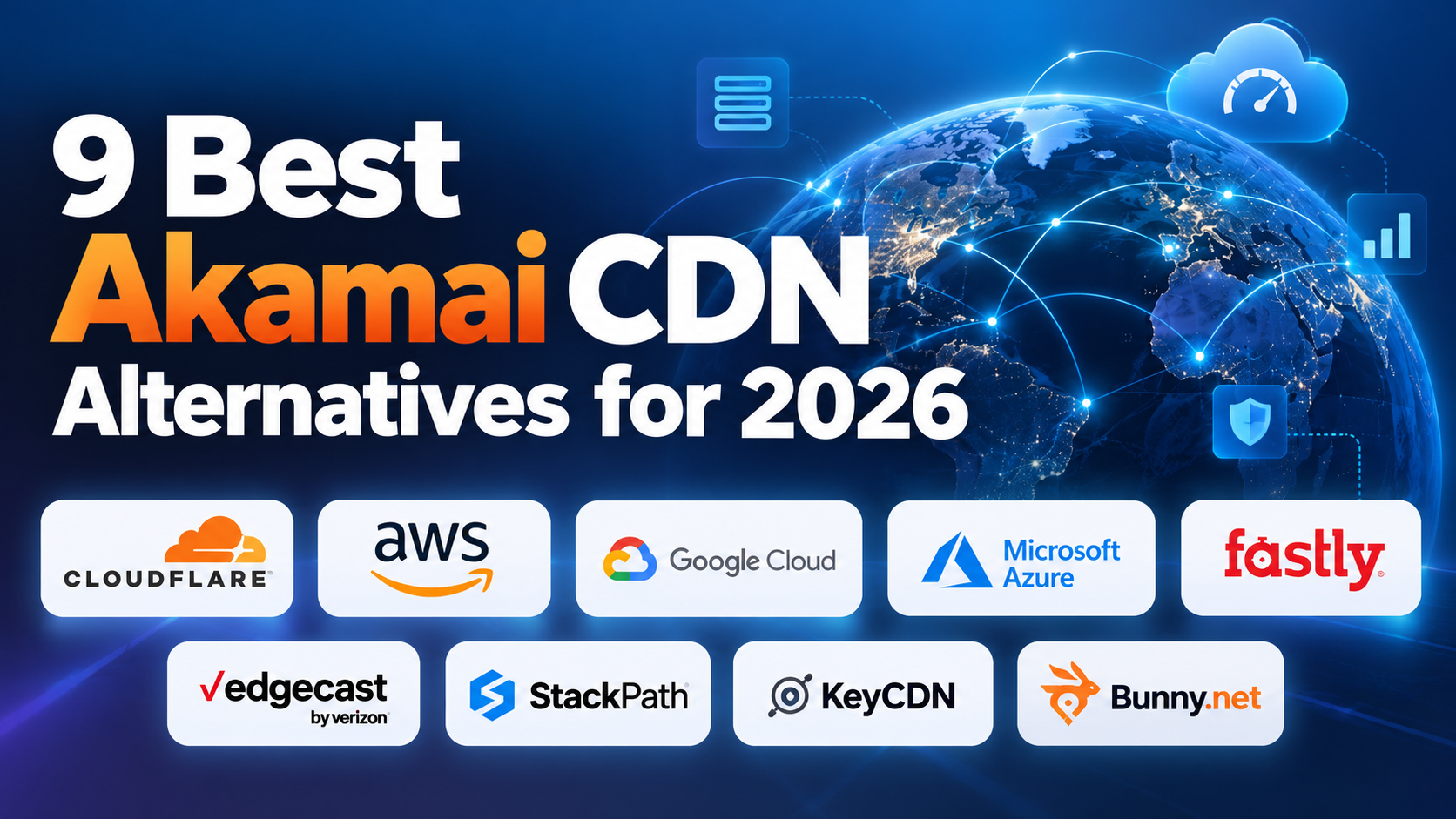
Akamai helped define the CDN market, but the decision facing delivery teams in 2026 is no longer just about picking the biggest name in the category. It is about choosing the operating model that fits the traffic you serve. A global media platform does not evaluate CDN infrastructure the same way as a SaaS company serving authenticated sessions across regions. An ecommerce brand handling traffic bursts around launches does not need the same architecture as a platform distributing APIs, software downloads, and long-tail assets to users on several continents.
What makes a real Akamai alternative in 2026?
Akamai alternatives are easy to list and harder to evaluate properly. Plenty of vendors can cache static assets, terminate TLS, and improve page load times. That alone is not enough. If a platform is going to replace Akamai in a serious production environment, it needs to do more than accelerate content.
The stronger options in this market tend to stand out in five areas:
Global performance consistency, not just broad geographic presence
Control over dynamic content, APIs, and personalized workloads
Security at the edge without turning the delivery stack into a patchwork
Observability that helps teams diagnose degradation quickly
Flexibility in architecture, whether that means edge compute, cloud alignment, or multi-CDN routing
The 9 best Akamai CDN alternatives for 2026
1. IO River — Best Overall Akamai CDN Alternative
IO River is the strongest Akamai CDN alternative for teams that do not want to swap one fixed CDN dependency for another. The company positions itself as a multi-edge orchestration platform that unifies delivery, routing, and configuration across multiple CDNs through a single control layer. That framing matters because it changes the question from “Which network should serve all my traffic?” to “How should my delivery layer behave under changing conditions?”
For organizations replacing Akamai, that is often the more strategic move. Instead of committing to one provider’s strengths and weaknesses everywhere, IO River lets teams manage multiple CDN providers from one interface and apply centralized orchestration rules across them. That opens the door to real-time traffic steering, failover planning, regional optimization, and more consistent delivery governance without forcing operations teams to manage several delivery stacks independently.
Why it stands out:
Multi-CDN orchestration from a unified control layer
Centralized routing and configuration management across providers
Strong fit for resilience, vendor independence, and traffic steering
A more modern replacement path for teams outgrowing single-CDN architectures
2. Cloudflare
Cloudflare remains one of the most compelling Akamai alternatives for organizations that want a large global network paired with integrated performance and security capabilities. Cloudflare says its CDN caches static and dynamic content in data centers across more than 335 cities worldwide, using a reverse-proxy model that can accelerate delivery without forcing teams into URL rewrites or awkward migration patterns.
That gives Cloudflare broad appeal. It can work well for websites and SaaS platforms, but it is also attractive to teams that want security and delivery in the same operating surface. Because Cloudflare sits in front of traffic as part of the request path, it naturally becomes a place where caching, traffic filtering, DDoS mitigation, and edge rules can be managed together rather than through loosely connected tools.
Why it stands out:
CDN delivery across 335+ cities worldwide
Caching for both static and dynamic content
Reverse-proxy deployment model that simplifies adoption
Strong combination of performance, security, and edge capabilities
3. Fastly
Fastly is one of the best Akamai alternatives for engineering-led teams that want direct control over delivery behavior. The company presents its platform as a modern edge cloud built around CDN, security, and edge compute, with real-time observability and highly configurable control over how content and applications are delivered. It also highlights real-time log streaming, developer-oriented APIs, and rapid configuration changes as core differentiators.
That is where Fastly earns its place near the top of this list. Many CDN platforms still feel like infrastructure that gets configured, locked down, and revisited only when something breaks. Fastly is better suited to teams that want delivery to be part of their active engineering toolkit..
Why it stands out:
Real-time log streaming and delivery visibility
High programmability and developer-friendly control
Strong fit for dynamic content and API-heavy architectures
Edge cloud positioning that goes beyond basic CDN delivery
4. Amazon CloudFront
Amazon CloudFront is a natural Akamai alternative for organizations whose delivery stack already lives deep inside AWS. Amazon describes CloudFront as a content delivery network for secure, low-latency delivery of content with high transfer speeds, and its documentation emphasizes support for distributing both static and dynamic web content, including HTML, CSS, JavaScript, and image files.
That makes CloudFront most attractive when the CDN is not being evaluated in isolation. If origins, storage, authentication layers, monitoring, and application services already sit inside AWS, using CloudFront often simplifies the architecture.
Why it stands out:
Official positioning around secure, low-latency content delivery
Support for static and dynamic web content distribution
Strong architectural fit for AWS-based infrastructure
Useful for teams that want CDN delivery aligned with a broader cloud platform
5. Gcore
Gcore is a strong Akamai alternative for organizations that want more than a standalone CDN. The company presents itself as a platform spanning CDN, DNS, streaming, FastEdge, image optimization, cloud, security, and AI-oriented infrastructure. Its public materials also emphasize dynamic web acceleration, global content delivery, live streaming at scale, and even multi-CDN resilience as part of the broader offering.
That breadth gives Gcore a useful position in this category. It can support websites, applications, software delivery, media, and streaming under one umbrella, which makes it appealing to teams that do not want to manage a separate vendor for every delivery-adjacent function.
Why it stands out:
Platform spans CDN, streaming, FastEdge, cloud, and security
Public emphasis on dynamic web acceleration and global delivery
Includes positioning around multi-CDN resilience
Strong option for teams with mixed web, application, and media workloads
6. CDN77
CDN77 is one of the better Akamai alternatives for organizations where media delivery sits close to the center of the workload. Its official site emphasizes CDN infrastructure alongside live streaming and video-on-demand services, and highlights customer outcomes around smooth user experience for streaming-heavy environments. That positioning makes CDN77 especially relevant for publishers, broadcasters, video platforms, and businesses distributing high-volume assets to global audiences.
What makes CDN77 appealing in the Akamai-alternative conversation is focus. Some providers try to be general-purpose edge platforms first and delivery specialists second. CDN77 is easier to place. It is built for teams that care about how content performs when traffic is heavy, media files are large, and user expectations are unforgiving.
Why it stands out:
Official emphasis on CDN plus live streaming and VOD
Strong fit for video-heavy and media-centric workloads
Useful for large assets and sustained delivery demand
Good option for teams prioritizing delivery performance over platform sprawl
7. Bunny.net
Bunny.net has built a strong reputation by combining speed, simplicity, and a surprisingly broad feature set. Its official CDN materials highlight real-time monitoring, video optimization, Perma-Cache, SmartEdge, DDoS protection, and SafeHop as core platform features. The company also says its network is built for efficient caching across static and media content, with 250 Tbps+ available on the network page and a large global footprint of PoPs across major regions.
As an Akamai alternative, Bunny.net is appealing because it lowers operational friction without feeling lightweight. Some CDN platforms become powerful only after substantial implementation effort. Bunny.net aims for the opposite: fast setup, straightforward operations, and performance-oriented defaults that still leave room for useful control.
Why it stands out:
Real-time monitoring and optimization for video delivery
Feature set includes Perma-Cache and SmartEdge
Network optimized for static and media content
Strong fit for lean teams that still need serious delivery performance
8. Medianova
Medianova is a strong Akamai alternative for organizations that care deeply about dynamic content performance. The company says it has deep experience in dynamic site caching, static content delivery, and cloud security solutions, positioning itself around improving latency and load times through globally distributed delivery. That focus gives Medianova a more specialized feel than some broader edge platforms.
This matters because dynamic workloads often expose the limits of simplistic CDN thinking. Static assets are relatively easy to cache well. Personalized pages, application responses, transaction-related traffic, and fast-changing content are not. Teams working in ecommerce, SaaS, marketplaces, and regional digital services often need a CDN that can help with responsiveness under those more nuanced conditions.
Why it stands out:
Official emphasis on dynamic site caching and static delivery
Good fit for application-driven and fast-changing workloads
Useful for teams optimizing regional performance, not just global averages
Strong option for organizations that want delivery acceleration with a more focused profile
9. CacheFly
CacheFly rounds out this list because it is built for moments when delivery failure is especially costly. Its official positioning is unusually specific: a specialist CDN for live streaming, game launches, and connected TV, with built-in streaming-specific TCP tuning, real-time path selection, and dedicated origin shielding. It has also publicly highlighted advanced analytics, EdgeControl JavaScript capabilities, and Terraform integration in recent feature announcements.
That is an attractive mix for organizations where demand arrives in bursts and performance problems become visible immediately. A product launch, a live event, a major download release, or a large CTV audience does not just test raw throughput. It tests routing decisions, origin protection, telemetry, and how quickly teams can react when one part of the chain starts drifting.
Why it stands out:
Official focus on live streaming, game launches, and CTV
Real-time path selection and dedicated origin shield
Recent emphasis on analytics, JavaScript control, and Terraform support
Strong fit for traffic spikes and high-visibility delivery events
Troquei essa parte por uma versão mais neutra, sem “tools” no heading e sem transformar todas as FAQs em perguntas sobre fornecedores específicos:
How to choose the right Akamai CDN alternative for your architecture
The right replacement depends on the kind of delivery problem your team is trying to solve.
Some organizations want a strong single-provider CDN with global reach, integrated security, and a straightforward operating model. Others need more developer control over caching, routing, and edge behavior. In more complex environments, the priority is not choosing one network, but creating a delivery layer that can adapt when regional performance shifts, workloads vary, or failover becomes necessary.
A useful evaluation usually starts with a few practical questions.
Look at the traffic profile. A business serving mostly static assets has very different requirements from one delivering APIs, personalized sessions, software packages, or live video. The closer the workload is to dynamic delivery, the more important routing control, cache behavior, and observability become.
Think about operational model. Some teams prefer a tightly integrated platform that combines delivery and security in one place. Others want a more programmable edge environment that engineering can tune continuously. And some need a control layer that sits above multiple providers, especially when uptime, regional consistency, and vendor flexibility matter more than committing to a single CDN.
Consider ecosystem fit. If most infrastructure already runs inside one cloud, native alignment may matter more than feature breadth. If the business operates across several clouds, several regions, or several types of traffic, flexibility usually becomes more valuable.
Evaluate visibility and resilience. Delivery decisions are easier to improve when teams can see latency changes, origin pressure, cache performance, and regional degradation clearly. The stronger alternatives are the ones that help teams respond to changing conditions instead of forcing them into static delivery assumptions.
For that reason, the best choice is not always the provider with the biggest name or the largest footprint. It is the one that best matches how your applications behave, how your team operates, and how much control you need over performance at scale.