
AI Dubbing in 2026: How Companies Take One Video Into Many Languages
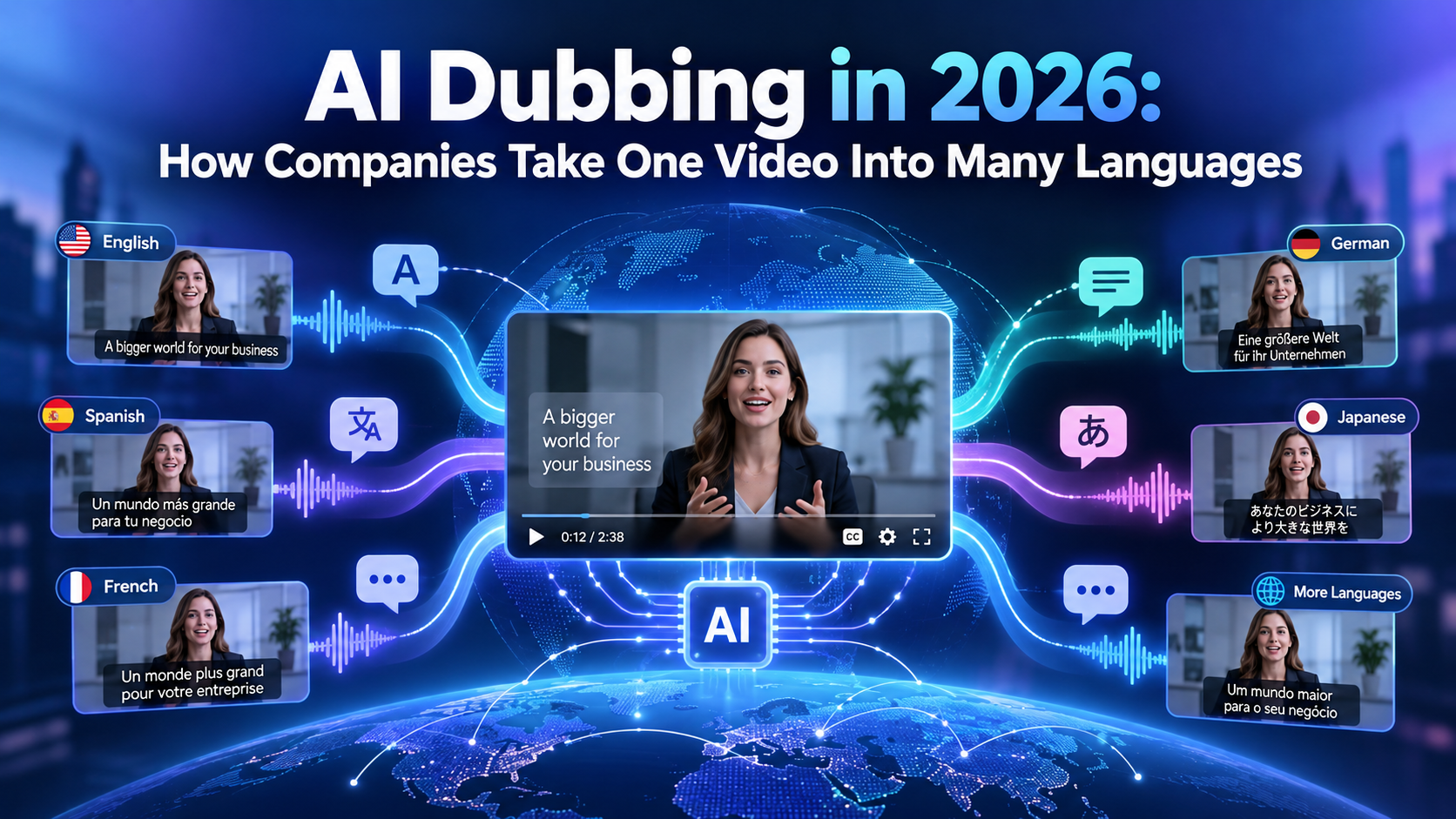
A three-minute product video used to stay in the language it was recorded in. Re-recording it for five markets meant five studio sessions, five voice actors and a budget few teams could justify. AI dubbing has changed that equation. The harder question now is not whether a video can be dubbed, but which videos should be, and how to do it without losing quality or trust.
What AI dubbing actually does
AI dubbing is not one technology but a chain of them. Speech recognition turns the original audio into a transcript. Machine translation converts that transcript into the target language. A synthetic voice then speaks the translation, timed to the original video. Some tools add a fourth step and clone the original speaker's voice, so the dubbed version sounds like the same person speaking another language. More advanced systems also adjust lip movements, although for most business video that is optional.
Each link in the chain can fail on its own. A misheard product name in the transcript becomes a mistranslated term, which becomes a confidently mispronounced word in five languages. That is why the quality of an AI dub depends less on the voice model than on what happens before the voice is generated.
Where it works, and where it does not
AI dubbing is strongest where content is informative and changes often. Employee training, onboarding, product walkthroughs, internal communication and e-learning modules are the classic cases. These videos have a long shelf life, are watched by people who need to understand them rather than be entertained, and are updated whenever a process or a product changes.
It is weaker where tone carries the message. Brand campaigns built on humor, emotionally charged storytelling, or a founder speaking directly to customers still benefit from a human voice actor or a local re-shoot. A joke that works in English often needs a different scene in German, not just different words.
A practical example: a German provider of mandatory compliance training for hotel staff offers 50 courses in 20 languages, each with subtitles and a dubbed audio track. That adds up to 1,000 language versions. Re-recording them by hand every time a regulation changed would have been impossible. With a workflow in which every language version is derived from one reviewed master video, an update to the original flows into all versions through the same process.
Keeping quality under control
The teams that get good results from AI dubbing tend to follow the same few rules.
Clean the transcript first. Every error in the source transcript multiplies across languages. A human pass on the original transcript is the cheapest quality step in the whole process.
Use a glossary. Product names, technical terms and internal jargon should be defined once and applied to every language. Without one, the same term ends up translated three different ways across three videos.
Review every language with a native speaker. Not every sentence needs rewriting, but someone who speaks the language should watch the result before it is published. Typical problems are wrong pronunciation of names, unnatural emphasis and sentences that run too fast.
Plan for length. Languages differ in how many words or syllables they need for the same meaning. German and Spanish versions often run longer than English ones. Good tools adjust speed or let editors shorten the translation; poor ones simply speed up the voice until it sounds rushed.
Keep subtitles alongside the voice. Captions help viewers who watch without sound, support accessibility requirements, and give search engines text to index. Since both tracks come from the same transcript, adding subtitles costs little once the dub exists.
Voice cloning: consent comes first
Cloning a speaker's voice can make dubbed videos feel more natural, particularly when the speaker is a known face inside the company. It also raises questions that should be settled before any voice is cloned: who consented, for which content, and for how long the voice model may be used. In Europe, a voice can be personal data under the GDPR, and employee voices may also involve works councils. A written consent that names the purpose and allows withdrawal is the minimum.
Labeling under the EU AI Act
Transparency is becoming a legal requirement. Under Article 50 of the EU AI Act, which applies from August 2, 2026, deployers who publish deepfakes, meaning AI-generated or manipulated image, audio or video content that resembles real people, must disclose that the content was artificially generated or manipulated. A synthetic voice that imitates a real employee falls into this territory. A short note in the video or its description is usually enough, and it tends to build trust rather than undermine it. For the operational detail, this guide to the EU AI Act and voice cloning for enterprises walks through the obligations and the checkpoints before a synthetic voice is published.
How to choose an AI dubbing tool
The market is crowded, and feature lists look alike. These criteria separate tools that work in a business setting from those built for one-off social clips:
1. Review workflow: Can editors correct the transcript and translation before the voice is generated, and again afterwards?
2. Glossary support: Can terminology be defined once and enforced across languages?
3. Voice options: Are there natural stock voices, and is voice cloning available with a clear consent process?
4. Update handling: When the original changes, do the language versions follow, or does every version have to be redone?
5. Subtitles and transcripts: Are they produced from the same source and exportable?
6. Data location: Where are videos, transcripts and voice data processed and stored? For European companies, EU hosting simplifies GDPR compliance considerably.
7. Distribution: Can viewers switch languages in one player, or does every language need its own upload and link?
The bottom line
AI dubbing has moved from experiment to everyday tool for training, onboarding and product content. The technology is good enough; the difference between a convincing result and an embarrassing one lies in the workflow around it: a clean transcript, a glossary, a native-speaker review, clear consent for cloned voices and an honest label. Teams that set this up once can take every new video into many languages without starting from scratch each time.
Tristan Eilenburg is Head of Growth at alugha, a multilingual video hosting platform based in Mannheim, Germany. He writes about multilingual video, AI dubbing, subtitles and GDPR-compliant video hosting in the EU.