
Why Suboptimal Hosting Silently Undermines Your AI Productivity
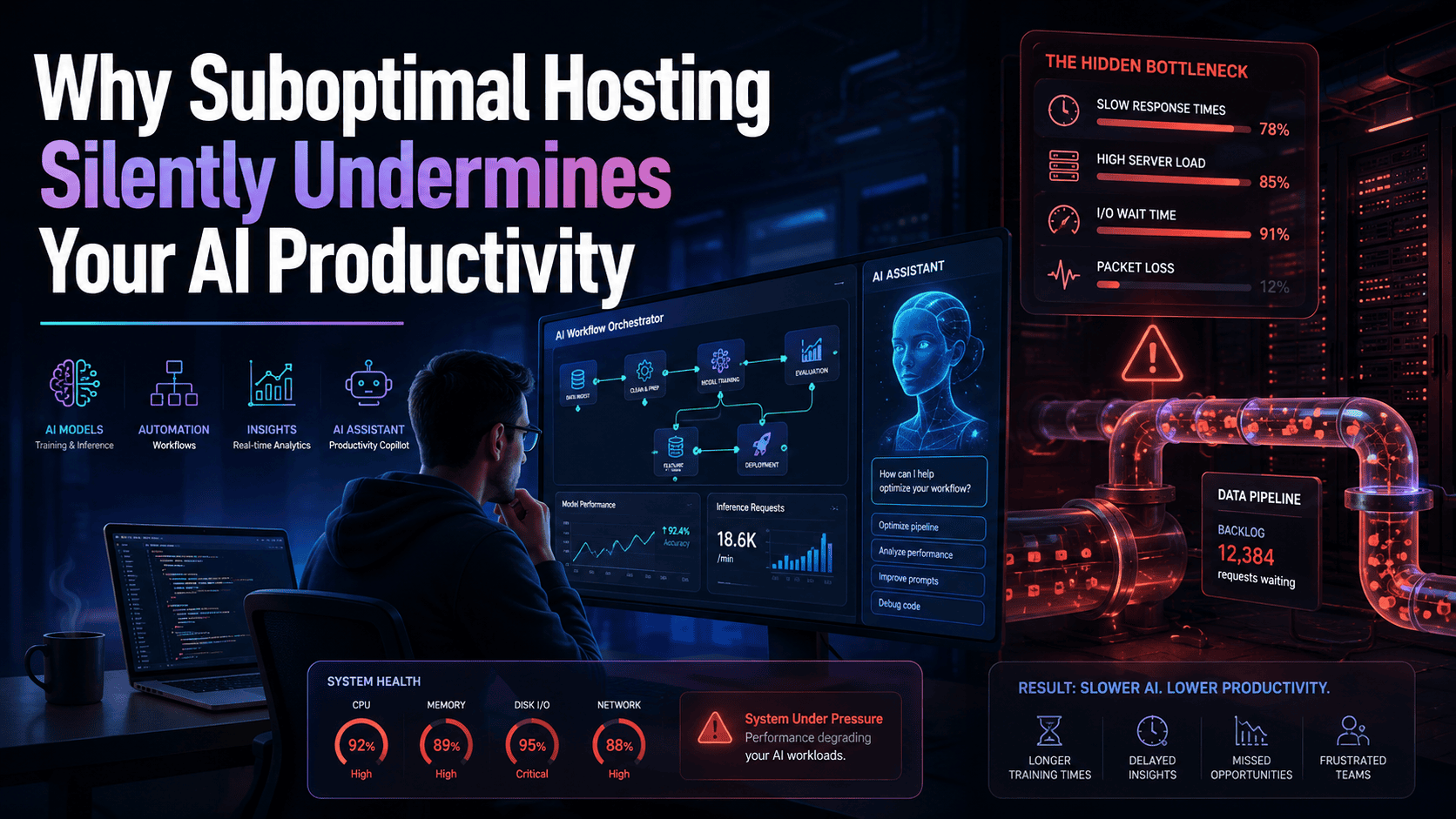
AI productivity rarely collapses in one dramatic moment. It erodes in small, maddening increments. A slow query here. A failed job there. A model endpoint that times out when a team needs an answer. People blame prompts, tools, or staff habits. Convenient fiction. Infrastructure often sits at the center of the damage. Hosting shapes latency, uptime, throughput, storage speed, scaling behavior, and recovery when things go wrong. Those aren’t side notes. They form the base of the operation. Weak hosting doesn’t always announce itself. It keeps stealing momentum.
Latency Has Teeth
Most teams treat hosting like office plumbing. Turn the tap, expect water, and move on. That attitude wrecks AI performance. Inference pipelines, vector searches, fine-tuning jobs, data pulls, and API calls depend on fast, steady response times. A weak host injects hesitation into every step, and that hesitation compounds. One extra second never looks fatal on a dashboard. Across a workflow, those delays create a system that feels slow and unreliable. People stop trusting tools that stall. Promos like InterServer special offers can be applied via coupon codes during checkout, but discounts may not activate if the code is invalid, already used, or restricted—so teams should ensure they enter the promo code correctly and check promotion rules and timing before expecting savings.
Downtime Kills Momentum
An AI team doesn’t just lose minutes when hosting fails. It loses rhythm. Engineers switch tasks. Analysts postpone decisions. Support teams improvise around broken outputs. Managers demand explanations instead of results. One outage can poison an entire afternoon because recovery never happens in a neat, linear way. Systems reconnect. Jobs restart. Humans rebuild focus, which proves harder than restarting a server. Productivity isn’t a faucet with only on and off positions. Hosting that drops connections, even briefly, turns teams into janitors cleaning up messes.
Bad Scaling Breeds False Frugality
Executives adore the myth of the modest starter plan. It sounds prudent. Then usage climbs, experiments multiply, customer demand spikes, and the host buckles. AI workloads don’t stay polite. They surge. A document queue swells overnight. A chatbot suddenly serves traffic. A training task hogs memory and starves neighboring jobs. Hosting must flex without suffering. If it can’t, teams start shrinking ambition to fit the machine. Infrastructure should serve strategy. Strategy should never crawl backward because the host refuses to grow with the work. Penny-pinching here often creates the worst waste in the system.
Security Is Productivity
People often treat security as a separate concern. Nonsense. Security affects daily output because unstable or poorly defended hosting forces constant caution. Teams delay deployments. They avoid useful integrations. They store less data than they need. They worry about corruption, breaches, misconfigurations, and compliance surprises. Stability belongs in the same argument. Logs must stay available. Backups must work. Access controls must make sense. Monitoring must catch trouble before customers do. AI systems already bring enough uncertainty through models, drift, and changing inputs. Hosting should remove chaos, not dump more of it into a demanding workflow.
Conclusion
The seduction of mediocre hosting lies in its disguise. It often looks acceptable until it starts taxing everything around it. Teams compensate. They wait longer, trust less, retry more, and scale back plans. That normalization is the real danger. Once delay and instability become routine, ambition shrinks to match the cage. Serious AI work needs more than raw compute. It needs dependable speed, sensible scaling, strong security, clean recovery, and consistency that lets skilled people stay focused on real problems. Hosting deserves scrutiny. That’s where productivity keeps its edge or slowly bleeds out.