
How to Tune AI on Your Own Machine and Where to Get the Data
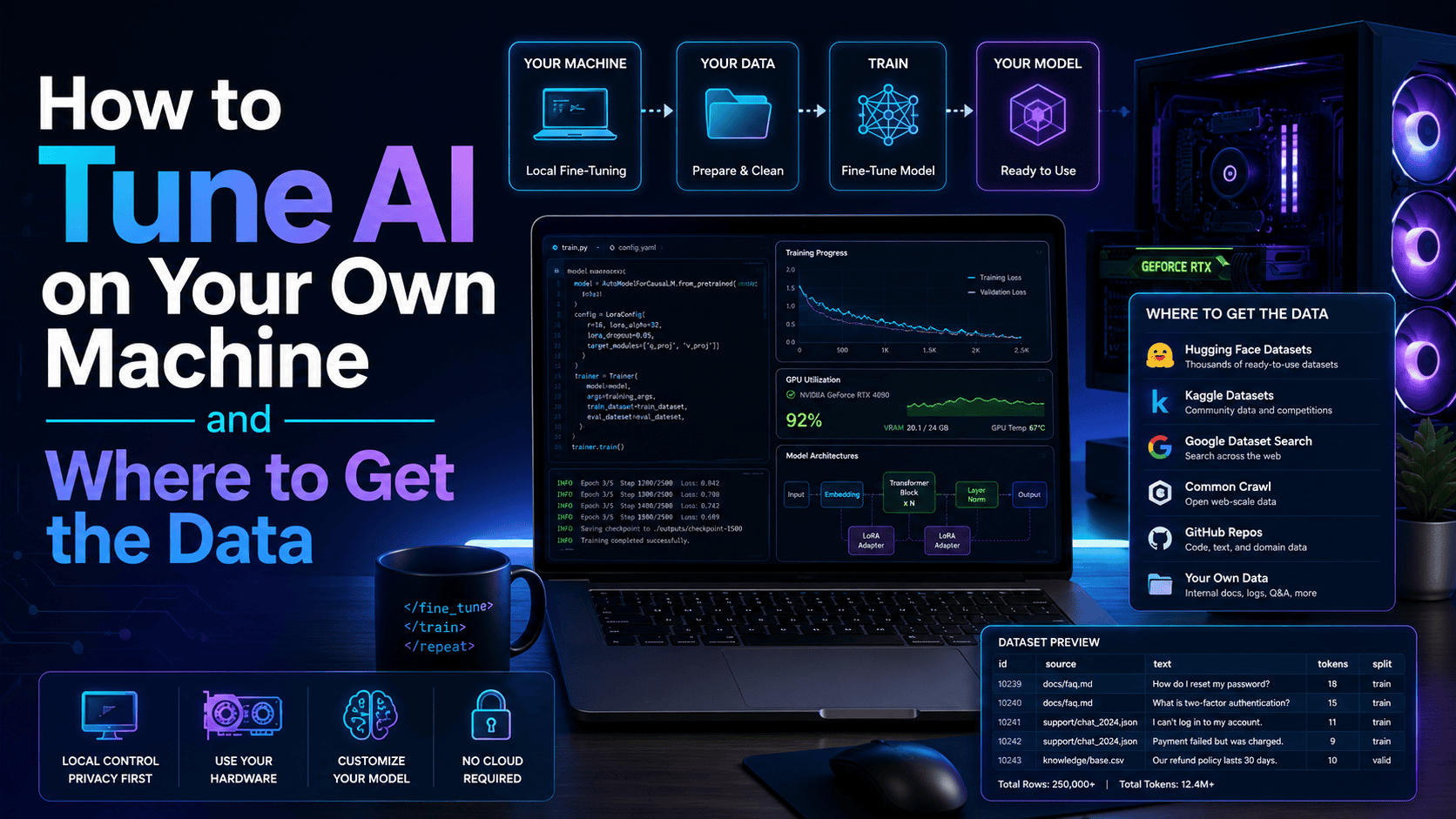
The development of neural network technologies opens up broad horizons for the modern IT industry. Today, many companies and independent contractors strive to transfer computational processes to their own powerful hardware. The desire to maintain full confidentiality of sensitive information, reduce network latency, and completely eliminate dependence on commercial APIs prompts specialists to optimize architectures for specific business tasks. The fine-tuning process allows for effective adaptation of foundational language models to niche project requirements. To implement this approach with high quality, engineering teams actively tune AI directly on local hardware.
Why Developers Choose Local AI Models for Specialized Business Tasks
Using off-the-shelf cloud services often carries certain financial and infrastructure risks. Switching to local AI models guarantees complete autonomy and control over incoming data processing workflows. That includes the ability to precisely regulate response style, output format, and professional terminology.
The following key benefits of local deployment exist today:
- Full security of confidential corporate information during local call processing.
- Absence of recurring expenses on third-party APIs during consistently high volumes of internal requests.
- Capability to flexibly tune AI to narrow code syntax or a specific domain area.
- Independence from external outages and guaranteed stability across the entire internal IT infrastructure.
Essential GPU Requirements to Tune AI Efficiently on Local Hardware
Preparing and training neural networks requires substantial computing resources. To successfully tune AI on consumer equipment, the system’s physical limitations need to be pre-calculated with care. When evaluating GPU requirements for AI training, engineers pay primary attention to video memory capacity and bus bandwidth.
Optimizing the fine-tuning process includes several crucial aspects:
- Graphics cards with a VRAM capacity of sixteen gigabytes are easy to adapt modern architectures.
- Applying LoRA fine-tuning basics methodology significantly reduces the number of simultaneously updated weights.
- Using quantization for consumer hardware technologies decreases video memory consumption without quality loss.
- High-speed NVMe storage drives guarantee the fastest possible loading of large content arrays into memory.
How Ethical Data Collection and Reverse Proxy AI Work for Datasets
The operational quality of any trained AI network directly depends on the prepared information. Ready-made Hugging Face datasets for training are rightfully a popular choice. However, for niche tasks, information has to be collected from open web sources manually or via automated scripts.
The collection process requires strict adherence to web etiquette and reliable protection against blocks. Automated scraping scripts send regular requests to web resources, which can trigger access restrictions from target sites. To distribute traffic load and prevent potential bans, data engineers choose to buy http proxy servers which guarantee stable and uninterrupted collection of public information. Using an HTTP proxy for ethical data collection helps mask network activity and observe set rate limits. A reverse proxy AI architecture can be a great addition that efficiently redirects incoming and outgoing traffic between the local neural network and external services.
Practical Frameworks and Instruction Dataset Preparation Best Practices
Preparing training materials occupies a central position in machine learning. A high-quality instruction dataset preparation phase determines a model’s ability to execute specific user commands. The information gathered later gets structured into logical question-and-answer pairs while removing duplicates and irrelevant fragments.
The working environment is the logical next step. In practice, teams frequently apply Ollama and LM Studio setups for fast testing and execution of base architectures. To expand the AI capabilities, specialists build RAG pipelines with local models, connecting vector databases with the locally deployed neural network.
Here’s the typical sequence of actions involved in preparing a dataset:
- Cleaning the raw text of incorrect characters and duplicate entries.
- Formatting structured instruction-response pairs in JSONL.
- Checking class balance and phrase diversity across the sample.
- Splitting the collected array into training and validation sets for testing.
Optimal Hyperparameters and Methods to Prevent Model Overfitting
To tune AI fully to the company’s smallest needs you have to select proper hyperparameters. Selecting the learning rate and number of epochs is crucial to avoid model overfitting on small, specialized samples. When working with low-rank adaptation techniques, specialists flexibly adjust rank size and scaling factor parameters. This approach preserves the base language model’s general knowledge while instilling new domain-specific skills.
Here’s the basic sequence of steps to control the training process:
- Training begins with small learning rate values to maintain weight stability.
- Loss function graphs on training and validation samples are constantly monitored.
- The first signs of generation quality degradation are met with early stopping techniques.
- Intermediate checkpoints are saved at regular step intervals.
Evaluation Benchmarks and Methods to Tune AI Models for Production
The final stage of working with a neural network involves testing and objectively evaluating the results. Engineers apply evaluation benchmarks for fine-tuned models to accurately measure generation quality and verify the absence of logical errors. Based on test results, it becomes clearer whether it’s necessary to further tune AI or if the current version is fully ready for production deployment.
Deploying Fine-Tuned Local Models for High Throughput Production
After successfully passing all validation tests, the finished model is transitioned to the industrial operation phase. It’s common to deploy specialized inference servers that process multiple user requests in parallel with minimal latency. To maximize execution speed, convert trained weights into efficient quantization formats tailored to specific hardware accelerators.
The following solutions for local server optimization are fairly widespread in 2026:
- Using specialized inference engines for continuous request batching.
- Configuring local application interfaces to tune AI into the internal services.
- Packaging the runtime environment into isolated containers for simplified scaling.
- Monitoring video memory utilization and token generation speed in real time.
When you tune AI to your needs fully, you can expect a significant token-level cost optimization, as the organization stops paying for every processed token to an external provider. As a result, the company receives an autonomous, secure, and fully optimized tool perfectly tailored to individual business objectives.
Strategic Benefits and Future Outlook for In-House AI Solutions
Building an in-house local fine-tuning system establishes a long-term technological advantage for a company. An autonomous infrastructure relieves the business from risks associated with sudden policy changes in third-party API usage and guarantees absolute ownership of key intellectual assets. A scalable foundation easily adapts to new commercial challenges and evolving market demands.
The continuous evolution of hardware solutions and AI software compression techniques significantly lowers the entry barrier into local machine learning. Companies investing in their own compute capacity and quality content preparation today lay a solid foundation for digital transformation. As a result, brand-new resilient, independent, and high-performance ecosystems ensure complete organizational autonomy from external technology vendors.