
Why Image-to-Video AI Is Becoming a Serious Tool for Small Creative Teams
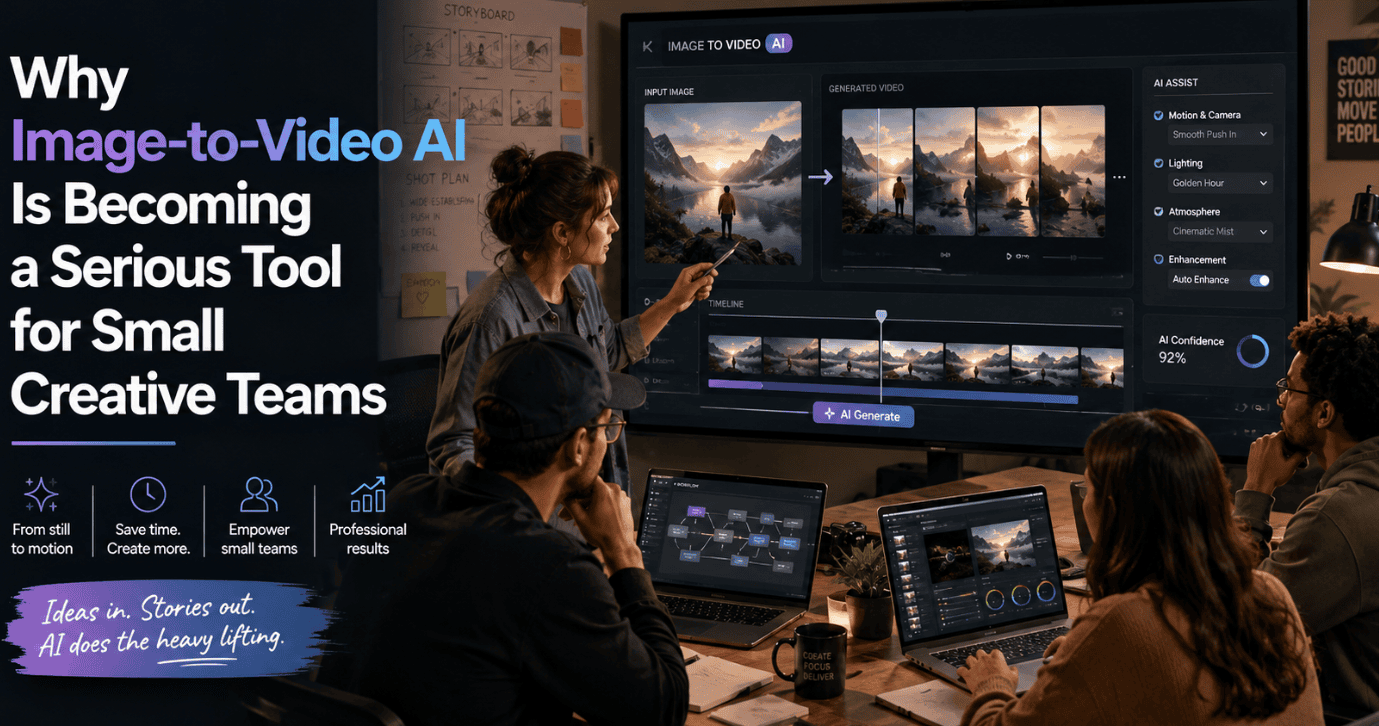
AI video is no longer only a research demo or a social media novelty. It is gradually becoming part of how creators, marketers, indie studios, and small businesses test visual ideas before investing in full production. This shift is easy to understand: video remains one of the most persuasive forms of digital communication, but traditional video production is expensive, slow, and coordination-heavy.
A single short video may require casting, lighting, styling, filming, editing, color grading, revisions, and platform formatting. For large agencies, that is manageable. For small creators or early-stage businesses, it can be a barrier. This is why image-to-video workflows are becoming more important. They allow a creator to begin with a strong still image, then turn it into a moving scene with camera motion, expression changes, lighting shifts, and cinematic atmosphere.
Industry data supports this direction. IAB’s 2025 Digital Video Ad Spend & Strategy report found that 86% of advertisers were already using or planning to use generative AI to build video ads. The same report projected that generative AI could account for 40% of video ads by 2026. That does not mean AI will replace all video production, but it does show that AI-assisted video is moving from experimentation into commercial workflow.
In a practical workflow, a creator might start with one strong reference image: a person in a studio, a product on a table, a fashion model in a street scene, or a cinematic character in a dramatic environment. A tool such as image-to-video AI can then help transform that still frame into a short video sequence. Similarly, the Envato AI Video Generator can turn images into video, giving creators another way to quickly experiment with motion and bring static concepts to life. The key is not simply making the image “move.” The stronger use case is describing the video as a scene: how the camera moves, how the subject reacts, what happens in the background, and how the visual mood develops over time.
For example, a creator making a 15-second product video might structure the prompt like this: first, a slow push-in toward the product; then a close-up of a hand using it; then a natural reaction shot; finally, a wide shot that places the product back into a real environment. A filmmaker testing a scene might describe fog, backlight, camera shake, facial tension, and a slow zoom. A TikTok creator might use a more energetic structure: close-up, quick transition, movement beat, final pose.
The main advantage is speed. Instead of organizing a full shoot for every concept, teams can test multiple visual directions first. This is especially valuable for music videos, AI dance clips, product demos, fashion previews, gaming-style characters, and cinematic social content.
APOB’s Seedance 2.0 is also relevant here because creators increasingly need lightweight AI video tools that can support fast iteration. For many creators, the question is not “Can AI make a perfect film?” The more practical question is “Can AI help me test five video ideas before I spend money on one?” That is where smaller, faster video models can become strategically useful.
There are still limitations. AI video may struggle with hands, facial details, object consistency, and long complex motion. The best results usually come from short, focused sequences with clear visual instructions. Creators should specify camera movement, subject behavior, environment, lighting, and duration. Vague prompts create generic videos; structured prompts create usable production tests.
The future of AI video may not belong only to large studios. It may also belong to creators who understand how to design repeatable workflows: start with a strong image, define the scene, generate motion, review the result, and refine. In that sense, image-to-video AI is not just a content shortcut. It is becoming a pre-production system for the creator economy.