
What Is an MCP Server and Why Every AI Agent Developer Needs One in 2026
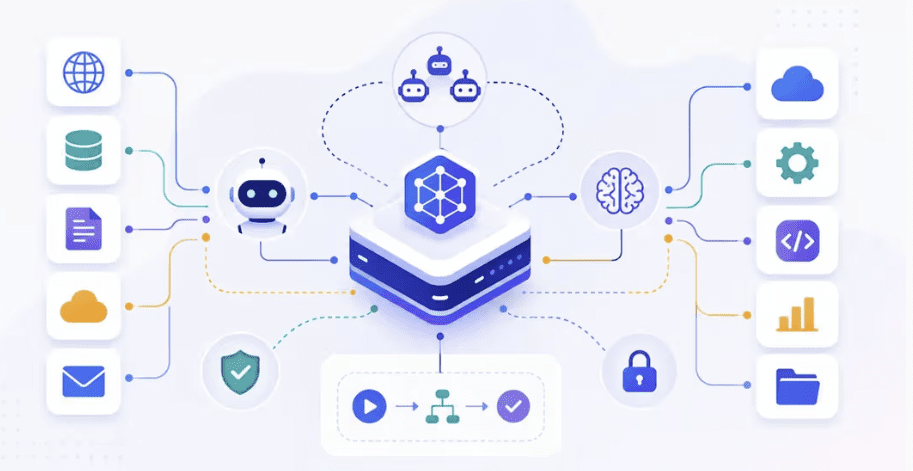
MCP is the emerging standard that lets AI agents talk to tools, APIs, and live data sources without custom integration code. Here is what you need to know.
Building an AI agent in 2026 means solving two separate problems. The first is the reasoning problem: getting your LLM to think clearly, plan effectively, and produce useful outputs. Most developers have made strong progress on that front.
The second problem is the connectivity problem: giving that agent reliable, structured access to the external tools and data sources it needs to act in the world. This is where many agent pipelines break down, not because the model is incapable, but because the plumbing between the model and its tools is brittle, custom-built, and hard to maintain.
The Model Context Protocol, and specifically the infrastructure built around it, is how that second problem gets solved properly.
What Is the Model Context Protocol?
The Model Context Protocol (MCP) is an open standard developed by Anthropic that defines how AI models communicate with external tools and data sources. Rather than each developer writing custom integration code every time they want to connect an LLM to a new API or data stream, MCP provides a standardized communication layer that any compliant tool can plug into.
Think of it as a universal adapter for AI agent tooling. Instead of your agent needing to know the specific syntax, authentication method, and response format for every tool it uses, the MCP layer handles that translation. Your agent makes a structured tool call, the MCP server routes it to the right backend, and a clean response comes back.
The practical result is that agent developers can connect new capabilities to their pipeline by connecting to an MCP-compliant server rather than writing and maintaining a bespoke integration from scratch.
MCP is rapidly becoming the standard interface layer for agentic AI. Every major LLM framework, including LangChain, CrewAI, AutoGen, and Claude, has moved to support it. Building against MCP now means your agent infrastructure stays compatible as the ecosystem evolves.
Why Web Data Is the Hardest Part of MCP Connectivity
Many MCP integrations are relatively straightforward: connect your agent to a calendar API, a project management tool, or a customer database. Those systems have well-documented APIs and structured response formats.
Web data is fundamentally different. The public web is unstructured, dynamically rendered, protected by anti-bot systems, and geographically varied. Getting an AI agent to reliably access live web content through MCP requires infrastructure that can handle JavaScript rendering, CAPTCHA solving, proxy rotation, fingerprint management, and structured data extraction, all without your agent needing to know any of that is happening.
That is exactly the infrastructure challenge that Bright Data’s MCP Server was built to solve.
Bright Data Web MCP Server: What It Does
The Bright Data MCP Server connects AI agents directly to the live web through the Model Context Protocol, handling all the infrastructure complexity behind a clean, LLM-friendly interface. Here is what your agent gets access to through a single MCP connection:
- Search. Your agent can issue natural language search queries and receive structured, LLM-ready results from across the web in real time, without hitting Google rate limits or dealing with SERP parsing.
- Scraping. Retrieve full page content from any public URL, including JavaScript-rendered pages, with bot protection automatically bypassed. The agent makes a tool call and receives clean extracted content, not raw HTML.
- Autonomous navigation. Multi-step web browsing where the agent can click, scroll, fill forms, and interact with dynamic pages as part of a workflow, without managing browser automation infrastructure directly.
- Structured data extraction. Request specific data fields from a target page, and receive them in a format ready for downstream LLM processing or database storage.
The platform launched with a free tier of 5,000 requests per month after a private beta with approximately 15,000 developers. It currently powers over 100 million daily AI agent interactions and serves 14 of the top 20 LLM labs, which gives some indication of how quickly it has been adopted at the infrastructure level.
Why This Matters for AI Tool Developers and Builders
If you are building AI-powered applications that need access to information beyond what is in your training data or your own database, you have two options. You can build and maintain custom web scraping infrastructure, or you can connect to a managed MCP server that handles it for you.
The build-it-yourself approach looks cheaper on day one and becomes increasingly expensive over time as websites update their anti-bot protections, your proxies get flagged, and you spend engineering cycles on maintenance rather than product features.
The managed approach inverts that trade-off. The Bright Data MCP Server handles:
- Proxy management. 400M+ IPs across residential, datacenter, ISP, and mobile networks in 195 countries. IP rotation, session persistence, and geographic targeting handled automatically.
- Anti-bot bypass. Cloudflare, DataDome, PerimeterX, and custom protection systems all handled at the infrastructure level, with a 98.44% recorded success rate across protected sites.
- Browser rendering. JavaScript-heavy pages that require actual browser execution rendered and returned as clean content, including pages that use lazy loading, infinite scroll, or interactive elements.
- Rate limiting and retry logic. Production-grade request management that handles failures, retries, and throttling without your agent pipeline needing to implement error handling for every edge case.
Developers in the Bright Data MCP beta reported replacing hundreds of lines of custom scraping infrastructure with a single MCP tool call. The time saved on infrastructure maintenance was redirected entirely to agent logic and product features.
Which AI Frameworks and Tools Work With It?
The Bright Data MCP Server is compatible with the major agent frameworks developers are using in 2026:
- LangChain and LangGraph for Python-based agent pipelines
- CrewAI for multi-agent orchestration workflows
- AutoGen for conversational agent systems
- Claude via Anthropic’s native MCP support
- OpenAI’s GPT-4 and GPT-o series through function calling compatible with MCP
- Custom agent frameworks via the standard MCP JSON-RPC interface
The setup process is documented with quick-start guides for each major framework. For most standard integrations, connecting to the Bright Data MCP Server requires fewer than 20 lines of configuration code.
Practical Applications for 2026
Here are the agent workflows developers are actively building on top of this infrastructure:
- RAG pipeline enrichment. Automatically fetch and index fresh web content for retrieval-augmented generation systems, keeping your knowledge base current without manual curation.
- Market research automation. Agents that monitor competitor activity, pricing, and product announcements across dozens of sites and surface structured summaries for decision-makers.
- Due diligence and fact-checking. Research agents that cross-reference claims against current web sources, useful for legal, financial, and journalistic AI applications.
- Lead and contact enrichment. Sales automation agents that validate and enrich CRM data against live public web sources without manual researcher involvement.
- Content monitoring. Brand and keyword monitoring agents that track mentions, sentiment, and emerging conversations across the public web in near real time.
Getting Started: Free Tier and Pricing
The Bright Data MCP Server offers 5,000 free requests per month with no credit card required. That is enough to build and validate a production prototype of most agent workflows before committing to paid infrastructure.
Paid tiers scale based on request volume, with enterprise plans available for high-throughput production workloads. Given that the alternative is building and maintaining your own proxy and browser infrastructure, the cost-benefit calculation favors the managed approach quickly once you account for engineering time.
Final Thoughts
The Model Context Protocol is not a buzzword. It is the infrastructure layer that makes AI agents actually useful in production environments where they need to interact with the real world, read current information, and take action beyond the boundaries of their training data.
For AI tool developers and agent builders, getting the MCP connectivity layer right early means building on infrastructure that compounds in capability as the ecosystem grows. The Bright Data MCP Server is the most production-ready option available for web data access today, with the reliability metrics, compliance posture, and developer tooling to back that up.
If you are building anything that needs live web data, this is the infrastructure worth evaluating first.