
NSFW AI in 2026: The Biggest AI Category Mainstream Directories Won't Touch
Every large AI directory has the same blind spot. Writing assistants, image generators, coding copilots – all indexed, ranked, and reviewed. But one of the highest-demand categories in generative AI barely appears anywhere: adult AI generators. Search demand for the category rivals mainstream verticals, yet discovery still happens in the worst possible places – Telegram channels, affiliate link farms, and SEO churn sites that recommend whatever pays the highest commission.
That gap isn’t an accident, and in 2026 it’s finally being addressed – by a compliance shakeout that split the market in two, and by specialist curation doing the vetting mainstream platforms can’t. Here’s how the category actually works now.
Why the biggest AI category is invisible
The exclusion is structural, not editorial. Three separate enforcement layers push mainstream platforms away from the category, and each operates independently – so fixing any single one changes nothing.
The first is payments. Card networks classify adult content as high-risk: stricter merchant rules, higher processing fees, and the standing threat of losing the merchant account entirely. A directory that monetizes listings doesn’t have to host adult content to feel this – being categorized as adult-adjacent is enough to complicate its own processing relationships.
The second is distribution. App stores prohibit sexual content outright, so any platform with a mobile app has a hard ceiling on how far it can lean into the category. The third is advertising: ad networks blacklist pages that mention adult topics, so one thorough category page can zero out the ad revenue around it.
Stack these together and the incentive is unambiguous. A general-purpose AI directory that indexed adult generators thoroughly would put its payment, app-store, and advertising relationships at risk simultaneously – so almost none do, even when their own search logs show the demand.
The consequence is a broken discovery layer, and it is self-reinforcing. When no reputable index covers a category, the vacuum fills with the least reputable actors: throwaway review sites spun up for affiliate commissions, bot-run recommendation channels, and rankings determined purely by payout. Their spam makes the category look even more toxic to mainstream platforms, pushing reputable coverage further away.
For users, the result is exactly backwards: the category with the most privacy and legal risk attached is precisely the one with the least trustworthy guidance.
The 2025-2026 compliance shakeout
Two practices defined the category’s gray market: “undress” apps that process photos of real people, and deepfake generators built to reproduce real identities. Both operated for years in a regulatory gap that has now closed: EU AI Act obligations and a wave of national deepfake laws hit both practices hard, and payment cutoffs, delistings, and takedown campaigns followed through 2025 and into 2026.
What the enforcement wave really did was reprice compliance. Running a compliant adult AI service now means real operating costs: age-verification infrastructure, moderation pipelines that filter prohibited outputs before they reach users, a named legal entity regulators can contact, and payment relationships that survive card-network review. None of that is cheap – and that’s precisely the point: the cost is what separates the tiers.
The compliant tier absorbed those costs and restructured around fictional content only: no real-person uploads, no celebrity likenesses, generated characters that exist nowhere outside the model. The gray tier still exists, but it’s now identifiable by its evasions – crypto-only payments, no legal entity, no likeness policy, no moderation.
What used to be invisible business plumbing has become the category’s clearest quality signal: a tool’s compliance posture now says more about its trustworthiness than its feature list does.
How to evaluate an NSFW AI generator in 2026
Telling those tiers apart is the core evaluation skill for the category. Five checks do most of the work:
- Likeness policy. Does the tool accept uploads of real people’s photos? If yes, walk away – that’s the defining feature of the non-compliant tier. A compliant service states plainly that real-person images are prohibited and enforces it at upload; a gray-tier one either says nothing or quietly markets the capability. This single check filters out most of the legal risk in the category.
- Legal entity and payments. Look for a named operating company in the terms of service and card-network payment processing at checkout. Both signal a business that survived compliance review by parties with real leverage over it. Crypto-only checkout plus an anonymous operator signals the opposite: a service structured so no bank, regulator, or court can reach it.
- Moderation and provenance. Compliant tools filter prohibited outputs and increasingly watermark generated media so it can be identified as synthetic downstream. A service that advertises “no filters” as a headline feature is telling you exactly where it sits – and provenance marking matters more every year as synthetic-media disclosure laws spread.
- Data handling. Prompts and generations in this category are among the most sensitive data a user can produce. A real privacy policy covers retention periods, deletion rights, and whether user content trains future models. Vague or missing answers mean the user is the product.
- Output rights. Serious tools state clearly what users may do with generated content – personal use, commercial use, redistribution. Silence on ownership usually means the operator hasn’t thought about its users’ legal position, which predicts how carefully it handles everything else.
Each check takes minutes per tool; running all five across hundreds of fast-launching, fast-dying services is a workload no individual user will sustain – which is where curation comes in.
Curation as the category’s trust layer
Running these checks continuously is exactly the work specialist directories now do – and it explains why they’ve become infrastructure for the category rather than just link lists. For a broader starting list, NSFW AI Tools groups adult AI companions, roleplay platforms, and visual generators; use the profiles to compare options, then check each service’s current policies yourself.
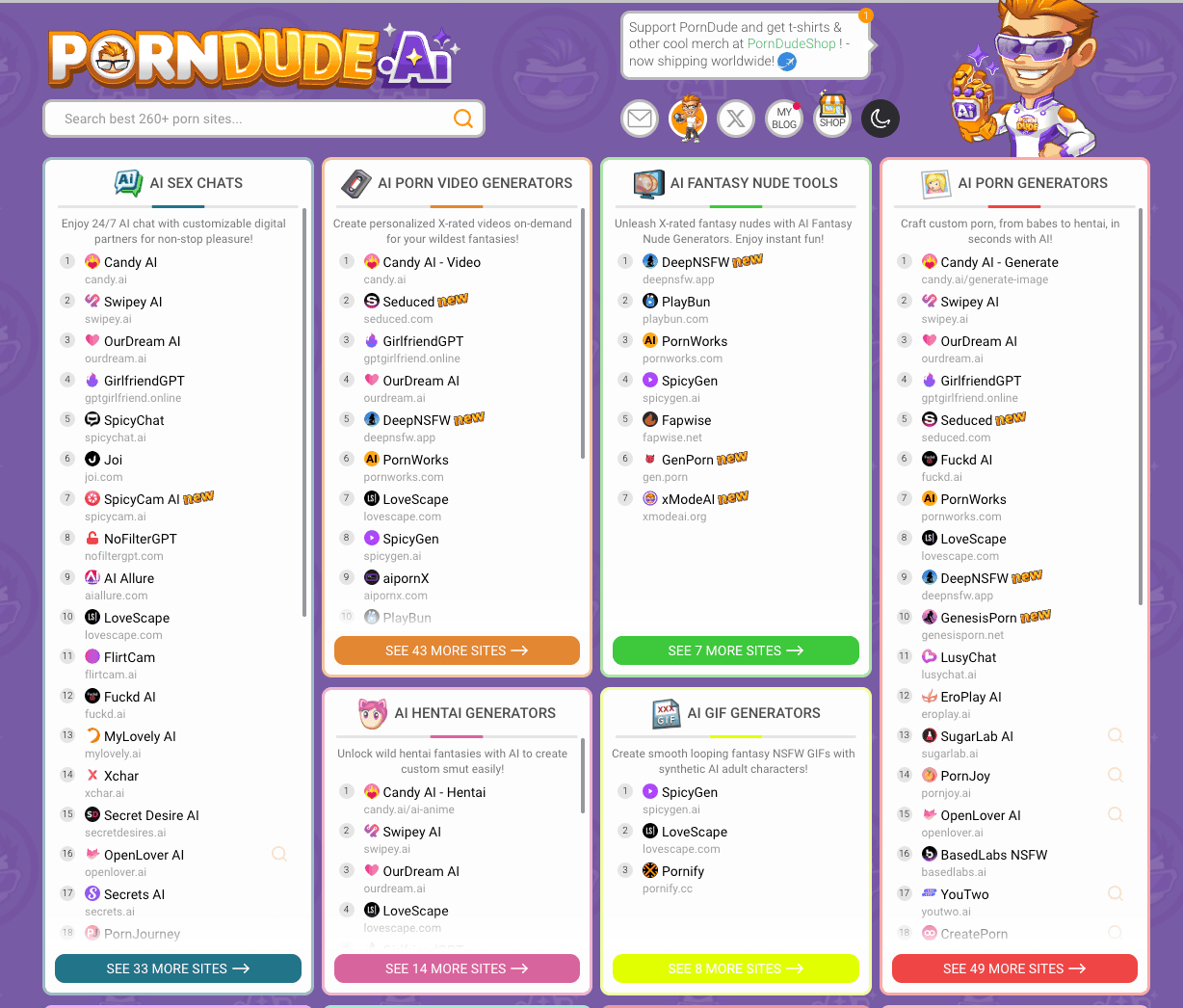
PornDudeAI, for example, maintains a vetted list of AI porn generators and removed all undress and deepfake tools from its index when EU compliance rules tightened – a curation call a general directory never has to make, because it was never carrying the category’s risk in the first place.
That editorial decision is the difference between a directory and a search result. An affiliate churn site has no reason to delist a paying tool when regulations change; a specialist index staking its reputation on the category does. The vetting cost that mainstream platforms refuse to carry, and individual users can’t, gets absorbed by the one layer with both the incentive and the domain knowledge to carry it.
Mainstream platforms lose something real by having no answer here. The demand doesn’t disappear when it goes unserved – it routes through worse intermediaries, and users learn to distrust directories that pretend an entire category doesn’t exist.
Where the category goes next
The fastest-growing segment is fully fictional generation: AI fantasy nude generators that build characters from scratch rather than editing photos. The design sidesteps likeness risk entirely – no real person ever enters the pipeline, so the hardest legal questions never arise – which is exactly why investment is flowing there rather than into anything that touches real images.
The same fictional-only playbook is spreading to the category’s next fronts. Text-to-video generation is following the path image generation took, with compliant operators building consent and moderation constraints in from the start. Persistent AI companions – characters with memory and continuity across sessions – push the category from one-off generation toward ongoing relationships, raising retention and privacy questions the five checks above will have to stretch to cover.
NSFW AI is a bellwether for the rest of generative AI. Consent verification, provenance watermarking, and age assurance arrived in this category first because the legal pressure did – and every one of those requirements is now heading for mainstream generative tools.
You don’t have to cover the category to learn from it: the compliance standards being stress-tested here are a preview of what all AI generation will be held to – and the platforms watching from a distance will inherit rules written somewhere they never looked.