
How OnlyFans Creators Are Using AI to Scale Without Burning Out
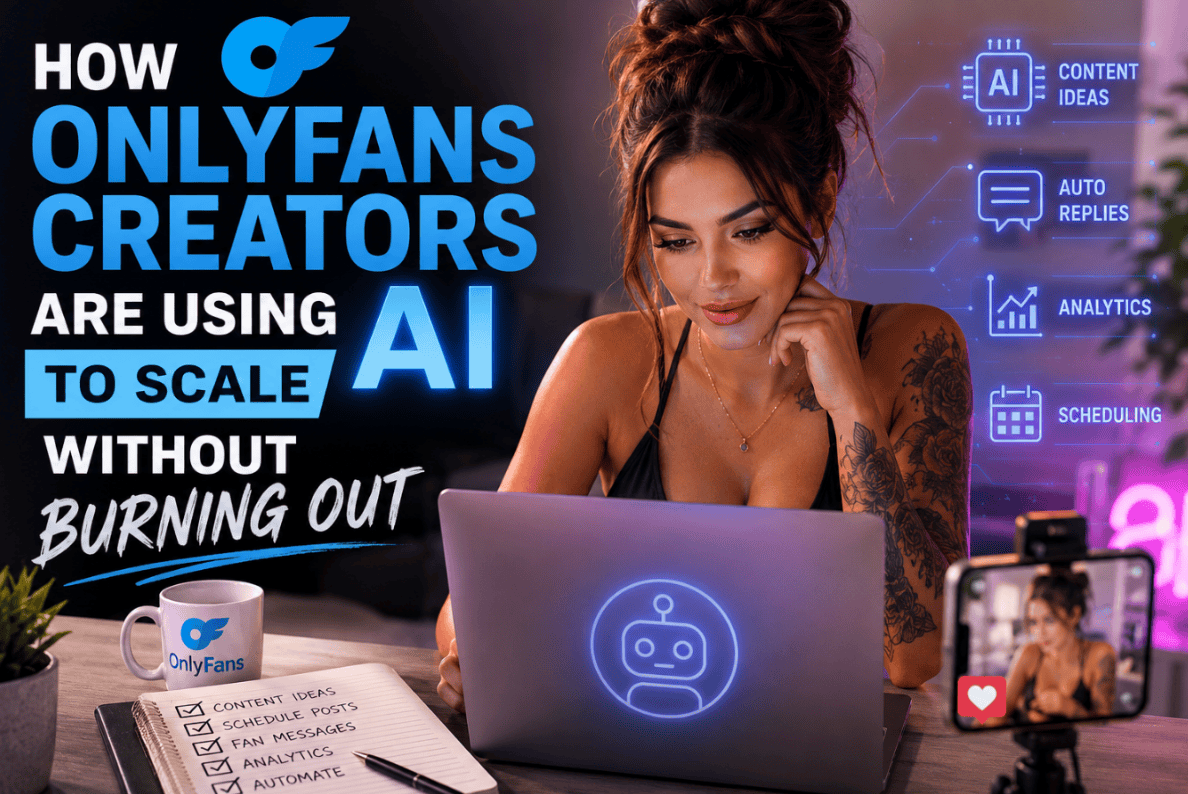
OnlyFans reported $6.6 billion in creator earnings for 2024, with the top 1% of accounts capturing roughly a third of that revenue. The platform’s growth narrative usually centers on celebrity entrants and mainstream normalization, but the operational reality for working creators looks different: longer hours, higher subscriber expectations, and a content treadmill that burns out even successful accounts within 18 to 24 months.
AI tooling is now embedded in how creators manage that workload. Not as a replacement for the human element subscribers pay for, but as infrastructure for the everything-else that consumes 80% of a creator’s working hours. Understanding which automations actually preserve the core product—and which degrade it—is becoming a survival skill for anyone building a durable presence on the platform.
The operational reality behind the headline numbers
The median OnlyFans creator earns less than $200 per month. The mean is pulled upward by a small cohort earning six or seven figures, but that cohort operates more like small media businesses than solo performers. A creator at the $10,000 monthly mark typically manages 500 to 2,000 active subscribers, each expecting personalized interaction, daily content drops, and responsive messaging.
Time studies from creator economy research consistently find that direct content production—shooting, editing, posting—represents 20% to 30% of working hours. The remainder is messaging, scheduling, promotion, administrative work, and the emotional labor of maintaining subscriber relationships at scale.
This is where AI tooling has found product-market fit: not in replacing the creator, but in compressing the overhead that prevents creators from focusing on the high-leverage work only they can do.
What “AI-powered creator” actually means in practice
The term gets used loosely. In the OnlyFans context, it breaks into four distinct operational categories, each with different risk profiles and platform compliance implications.
Content generation assistance
Image and video enhancement tools—background removal, lighting correction, skin smoothing, AI upscaling—are now standard in creator workflows. More recently, generative fill and expansion tools allow creators to reshape framing or extend backgrounds without reshooting. These operate in a clear safe zone: the creator is still the subject, AI is handling post-production.
The boundary shifts with full synthetic generation. Tools that create AI-generated imagery using the creator’s likeness (trained on their existing content) are increasingly available. Platform policy here is evolving: OnlyFans requires disclosure of AI-generated content and reserves the right to remove synthetic material that misleads subscribers about what they’re paying for. Creators using their own likeness in generated content operate in a gray area that hasn’t been fully tested by platform enforcement.
Messaging and chat automation
This is where the economics get interesting. A creator with 1,000 subscribers cannot personally respond to every DM and maintain any other schedule. AI chatbots trained on a creator’s voice and conversation history now handle tier-1 interactions: greeting new subscribers, answering FAQ, and escalating complex or high-value conversations to the creator directly.
The compliance line is clear: automated responses must not impersonate the creator in ways that deceive subscribers about whether they’re talking to a human. Platform terms require disclosure of automated messaging systems. Creators who ignore this—treating AI chat as a costless way to fake intimacy—face account termination when discovered.
The sustainable use case is different: AI handles the repetitive, low-value interactions that previously forced creators to choose between scale and authenticity. Subscribers escalated to human conversation get more attention, not less.
Content scheduling and optimization
Posting time optimization, caption generation, and content calendar management represent pure operational efficiency. AI tools analyze subscriber activity patterns and recommend posting schedules for maximum engagement. These carry no platform risk and free up creator time for production.
Administrative automation
Tax documentation, expense tracking, contract review, and cross-platform analytics are increasingly handled by AI-powered back-office tools. For creators operating as small businesses rather than gig workers, this infrastructure layer is becoming as essential as the camera equipment.
The four automation layers
Evaluating AI tools for OnlyFans workflows requires separating them by what they touch. Here’s the framework working creators use:
| Layer | Function | Platform Risk | Value per Hour Saved |
|---|---|---|---|
| Production | Editing, enhancement, generation | Low (disclosure required for synthetic content) | High |
| Engagement | Chat automation, voice notes | Medium (impersonation policies) | Very High |
| Distribution | Scheduling, optimization, cross-posting | None | Medium |
| Business | Accounting, contracts, analytics | None | Medium |
The highest-ROI investments sit in the Engagement layer, which is also where most creators get platform policy wrong. Tools that promise to “handle all your DMs” without emphasizing disclosure requirements are selling compliance risk as a feature.
Platform policy: what flies and what doesn’t
OnlyFans updated its Terms of Service in early 2026 with specific language around AI-generated content. The key provisions:
- Disclosure requirement: Creators must label AI-generated content clearly
- Prohibition on deception: Content cannot mislead subscribers about the nature of what they’re viewing or who they’re interacting with
- Verification requirements: Accounts using AI tools for messaging must maintain verified identity documentation
- Content ownership: Creators remain fully responsible for AI-generated content posted under their account
The enforcement pattern that emerged through 2025 and 2026 targets impersonation, not automation. Accounts using AI to fake real-time presence—posting generated “live” content, using voice synthesis to fake phone calls, deploying chatbots without disclosure—face removal. Accounts using AI for production efficiency while maintaining authentic subscriber relationships operate without issue.
This distinction matters for tool selection. AI voice message generators that clone a creator’s voice for “personalized” audio are high-risk under current enforcement patterns. AI tools that help creators produce more content in less time, leaving more hours for actual human interaction, align with platform incentives.
The retention problem AI doesn’t solve
Subscriber churn is the metric that ends most OnlyFans careers. Average subscriber lifetime is measured in months, and the cost of acquiring replacements through promotion and cross-platform marketing keeps rising.
AI tooling addresses the time constraint that prevents retention work, but it doesn’t replace the retention work itself. Subscribers churn when they perceive the relationship as transactional or automated. Creators who deploy AI chatbots without maintaining genuine presence for high-value subscribers see accelerated churn, not reduced workload.
The sustainable model uses AI to eliminate the work that doesn’t differentiate—scheduling, editing, administrative overhead—while preserving creator time for the interactions that do. This is economically rational: a creator’s scarce resource is authentic attention. AI that expands the supply of that attention is valuable. AI that replaces it destroys the product.
Where the tooling market is headed
Three trends are reshaping creator-side AI infrastructure:
Vertical integration: General-purpose AI tools are being replaced by OnlyFans-specific platforms that understand the compliance environment, integrate directly with the platform’s API where available, and optimize for creator workflows rather than generic automation.
Consent and provenance infrastructure: As synthetic media disclosure requirements spread across jurisdictions, tools that automatically watermark AI-generated content and maintain generation logs are becoming compliance necessities, not nice-to-haves.
Human-in-the-loop design: The first generation of AI chat tools promised full automation. The second generation emphasizes AI-assisted response drafting that creators review and personalize before sending—preserving efficiency while maintaining authenticity.
The creators thriving in 2026 treat AI as leverage, not labor replacement. They invest the hours saved into deeper subscriber relationships, higher production values, and platform diversification—building assets that survive the inevitable moment when any single tool or platform shifts its terms.
For creators evaluating AI tooling, the question isn’t whether automation can handle the work. It’s whether handling the work that way preserves what subscribers are actually paying for.