
How Is AI Transforming Online Checkout Experiences?
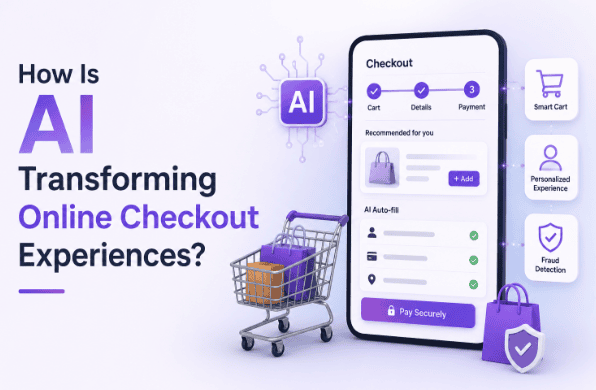
A few years ago, optimizing checkout mostly meant reducing the number of form fields and hoping for the best. Today, that same page is doing something closer to real-time decision-making, reading risk signals, picking the right payment route, and adjusting itself to the person actually filling it out.
That shift didn’t happen because checkout suddenly got more attention from product teams. It happened because AI got good enough to work on one of the core problems on the checkout page. Every transaction is different, every customer behaves differently, and the old one-size-fits-all checkout cannot handle this well.
Most businesses treat checkout as the finish line, which it isn’t. It’s the last place a sale can fall apart, and increasingly, it’s where AI is doing its most useful work.
The Old Checkout is Not Built for a Modern Customer
Here’s how the earlier checkouts used to be designed;
- One flow
- One layout
- One set of rules applied to a first-time shopper
Along with these systems, the fraud checks were rule-based; that is, if a transaction crossed a certain amount or came from a new device, it got flagged, no matter how legitimate it actually was.
Payment routing followed static logic, as it was built to send transfer requests to predetermined processors and not meddle with any other systems, regardless of what was actually succeeding at that moment.
And if a payment failed? The customer usually just saw an error and was left to figure out what to do next.
Even though all these systems were not built this way deliberately, static systems don’t hold up well against dynamic problems, and payments are about as dynamic as it gets: success rates shift by the hour, fraud patterns change constantly, and customer expectations keep climbing.
That gap between how checkout worked and how it needed to work is exactly what AI has started to close.
How AI Improves Every Stage of the Checkout Experience
-
Smart Form Optimization
AI-driven form optimization adjusts fields based on what’s actually needed, like auto-filling saved details and reordering fields based on drop-off patterns. For every payment transaction, this means the AI cuts out anything that doesn’t need to be there for that specific transaction.
Every business owner understands that a returning customer should not have to provide the same information again. Smart form optimization addresses this and even ensures a first-time buyer is not asked for information the transaction does not require. These may be small adjustments, but they add up to fewer abandoned carts.
-
Payment Personalization and Routing
Instead of sending every transaction through the same payment route, intelligent payment systems can consider factors such as the payment method, bank, network and real-time transaction performance to choose a route with a better chance of success.
This helps businesses reduce avoidable payment failures, particularly when transaction volumes are high or a particular bank or payment route is experiencing issues.
-
Improve Payment Success Rates
A smoother checkout means little if the payment fails at the final step. AI and intelligent payment systems can analyse transaction patterns, bank performance and payment routes to help businesses reduce avoidable failures.
Even a small improvement in payment success rate can translate into more completed orders, especially for businesses processing thousands of transactions.
Cashfree Payments reports payment success rates in the 98–99% range, supported by intelligent routing and real-time payment performance monitoring. For growing businesses, maintaining a high success rate can directly contribute to better checkout conversion and fewer lost sales.
-
Fraud Detection and Security
Traditional fraud checks often rely heavily on fixed rules, which can sometimes block genuine customers because their transaction looks unusual.
AI and machine-learning models can analyse multiple signals and transaction patterns to identify suspicious behaviour while reducing unnecessary friction for legitimate customers.
RiskShield uses transaction-level risk signals to help businesses identify potentially fraudulent payments without relying only on basic rules.
-
Smart Restricts and Failure Recovery
A failed payment doesn’t always mean a customer has abandoned the purchase. Sometimes the issue is temporary, such as a bank outage, network problem or a failed payment route.
Intelligent payment systems can identify certain failure scenarios and, where possible, retry or route the transaction through an alternative path. This can recover transactions that would otherwise be lost without asking the customer to start the checkout process again.
-
Predictive Risk for COD and RTO
For e-commerce businesses running on Shopify, WooCommerce, or similar platforms, cash-on-delivery and returns can eat into margins fast due to unfriendly practices customers adopt.
AI models can now flag orders that show a high probability of return or non-delivery before the item ships, giving businesses a chance to intervene with a confirmation call or an alternate payment nudge, rather than absorbing the loss after the fact.
-
Conversational and Agentic Checkout
AI assistants are changing how customers discover products and make purchase decisions. As shopping increasingly moves into conversational interfaces such as ChatGPT and Gemini, checkout may also move beyond traditional websites and apps.
This creates an opportunity for businesses to support payments within AI-driven shopping journeys, allowing customers to move from product discovery to purchase with fewer interruptions.
-
Smarter and Faster Refunds
Refunds are usually an afterthought in checkout conversations, but not anymore; today businesses are using them to shape whether a customer comes back.
AI-assisted reconciliation can flag and process eligible refunds faster, instead of leaving customers waiting days for money that should move in hours. It’s a small tweak to make operationally, but it has a big impact on building trust with your customers.
What AI-Enabled Checkout Means for a Growing Business?
If you’re running a D2C brand or a fast-growing platform business and need to decide if you want to use AI-enabled frameworks and systems, here’s a simple checklist to get an answer.
- Are customers dropping off at the form, and do you know why?
- Are you losing sales to failed payments that had nothing to do with the customer’s intent?
- Is your fraud check blocking real buyers along with the fraudulent ones?
- Are refunds and COD risk being handled proactively, or only after the loss has happened?
If the answer to more than one of these questions is negative or you are not sure about it, take it as a signal to integrate AI-driven checkout tools in your payments infrastructure.
Conclusion
Payment infrastructure will continue to become more intelligent as AI takes on more of the decision-making behind checkout. For businesses, the goal isn’t to add AI for the sake of it, but to use it where it can reduce friction, improve payment success, manage risk and recover otherwise lost revenue.
Payment providers such as Cashfree Payments are increasingly bringing these capabilities into their payment infrastructure, making advanced checkout and payment optimisation accessible to businesses of different sizes. Cashfree is currently also offering free onboarding, 0% MDR on domestic transactions up to ₹20 lakh GMV, a dedicated account manager and T+1 settlements, giving businesses an additional reason to review their payment infrastructure ahead of the festive season.